Conticello on MCC

April 28, 2008 by nezhmet

A Manhattan Chess Club Timeline [Abridged]

by Nicholas W. Conticello


Italicized Supplemental Notes by IM Mark Ginsburg

1901- Frank J. Marshall wins the first of three Manhattan Chess Club (MCC) titles.

1909- MCC organizes match between Marshall and young member Jose Raul Capablanca. The unknown Cuban demolishes the World Championship contender by +8-1=14 and goes on to become the third World Champion.

1915- Capablanca wins NY International ahead of Marshall.

1924- MCC board members arrange legendary New York international featuring most of the leading players of the era. Lasker takes first with 16-4 ahead of Capablanca, Alekhine, Marshall, Reti, etc. Capa’s loss to Reti in the fifth round is the Cuban’s first defeat in 8 years.

1927- MCC board sponsors a six-player event supposedly to select a challenger for Capablanca’s title. Capa wins without loss of a game, while Alekhine confirms his status as challenger with a convincing second. Alekhine’s ensuing victory in their match later in the year by +6-3=25 will shock the chess world and end MCC’s grip on the World Championship.

1936- MCC member Samuel Reshevsky wins first US Championship tournament of the 20th century.

1945- On Sept. 1 Club is site of American half of USA-USSR radio match. Soviets win by 11 points in 20 games and begin their 27 year grip (to the day!) on world chess.

1948- Members Reshevsky and Reuben Fine are invited to play in World Championship tournament to choose a successor to Alekhine. Fine, fearing Soviet collusion, cites his studies in psychology as his reason for not playing. Reshevsky plays anyway and finishes third.

1951- Reshevsky wins MCC’s Wertheim Memorial ahead of Max Euwe and Miguel Najdorf.

1952- Future GM and World Junior Champion William Lombardy joins the Club.

1955- Reshevsky wins the Rosenwald tournament (de facto US Championship) ahead of Arthur Bisguier and Larry M. Evans. 12-year-old Robert J. Fischer joins.

1956- Fischer is invited to the Rosenwald at age 13. He is beaten by eventual winner Reshevsky on time (his only known time forfeit) and runnerup Bisguier ( the latter’s only win against Fischer) but defeats Donald Byrne in what TD and Club Manager Hans Kmoch eulogizes as the “Game of the Century” and scores a respectable 4.5/11.

1957- In the space of one year, Donald Byrne wins the Western Open, Gisela Gresser wins the US Women’s title, Fischer wins the US Open and US Junior, Lombardy wins the World Junior Championship (11-0!), Arthur Bisguier wins the US Closed, and Samuel Reshevsky is crowned “Champion of the Western Hemisphere” by virtue of a match victory over Miguel Najdorf. The year will end with 14-year-old Bobby Fischer taking the first of a record 8 US Championships without the loss of a game.

1962- Larry Evans defeats William Lombardy for the Edgar Trophy.

1963- Fischer wins the US Championship for the sixth time with a perfect 11-0 score. The event is held at the Henry Hudson Hotel, which also was home for the Club.

1964- Benko defeats Bisguier in a match for an Interzonal spot vacated by Fischer, who declined his invitation to the Amsterdam event.

1971- The Club moves from the Henry Hudson to E. 60th St. just off Fifth Avenue. In August, the Club sponsors an invitational Master Rapids. Fischer swamps the field with 21.5-0.5 (the draw going to six-time Club Champion Walter Shipman.) This was the soon-to-be World Champion’s last appearance at the Club.

1973- The peak of the “Fischer Boom” sees the Club’s membership exceed 400.

1974- The “Boom” goes bust, and the Club must move again, to 155 E. 55 St. In February Viktor Korchnoi wins another special Master Rapids.

1976- The Club sponsors the first New York International since 1951. IM Norman Weinstein ties for first with recent emigre GM’s Anatoly Lein and Leonid Shamkovich. 12-year-old Joel Benjamin, making his international debut, wins a game from Canadian IM Bruce Amos.

1977- Anatoly Lein wins the Moses Mitchell Tournament of Champions ahead of Sal Matera, Bernard Zuckerman, and future Club President Neil McKelvie.

1978-14-year-old Joel Benjamin wins the first of six Club titles.

1984- The Club moves to the Carnegie Hall Studios, 155 W. 57 St, for the second time.

1988 - IM Mark Ginsburg (Yay!) wins the MCC Championship for the first time, with a field including MCC stalwarts Zuckerman and Shirazi. The 10th floor Carnegie Hall location features an 11th floor bathtub for the grimy combatant.

1989- Gata Kamsky’s American debut after defecting during the New York Open is the Club’s 4 Rated Games Tonight. Kamsky will play frequently at the Club over the next five years.

MG: I play Kamsky in an MCC quad. We have cordial post-game analysis until his father yanks him away mid-sentence, much like a bad vaudeville act gets the cane.

1989- The Club runs a Knockout Qualifier with sixteen of the country’s strongest players vying for the right to meet Kasparov in a two game 25 minute match at the New York Public Library. Gata Kamsky, a last minute substitute, wins the event ahead of many GM’s.

1990 - IM Mark Ginsburg (Yay!) wins the MCC Championship for the second time, granting a draw from a position of strength to FM Danny Shapiro in the last round. Leonid Bass and Mark are just in time to Maxim Dlugy’s wedding.

1991 - Despite having won the event two years previously, the gruff manager Russell Garber omits to invite MG to this year’s championship and MG misses it, not knowing its exact dates.

1992 - The Club and the American Chess Foundation purchase a building at 353 W. 46 St. in the hopes of providing the Club with a permanent home and enabling the Foundation to expand its activities. The site is called the American Chess Center.

1993- By June the Club is unable to maintain its share of the building and cedes its part ownership to ACF. Billy Colias is hired as manager in July, charged with running the Club and the ACF’s bookstore. he dies Nov. 4 from an accidental overdose of an over-the-counter-medication.

1994- Kamsky celebrates his match victory over Anand with a final appearance in the Thursday Night Action. He scores 4-0, defeating Lombardy and IM Danny Edelman en route.

1997- Jay Bonin becomes the first player to win the championships of the Marshall and Manhattan Clubs and the State of New York to become the only triple Crown winner in NY State history.

1999- Maurice Ashley gains his final GM norm in an International held at the Club, beconing the first African-American Grandmaster.

2000- The Club’s lease at 353 W. 46 St. expires. it moves to the New Yorker Hotel on May 1. A few weeks later GM Max Dlugy wins a Master Rapids event held concurrently with the New York Open to celebrate the Club’s reopening. In November Eric Cooke wins atwo-game blitz playoff from Asa Hoffmann to become the Club’s last champion in the 20th century.

2001 - MG visits the almost defunct club in this sad New Yorker Hotel (some non-descript room on a high floor) location.

2002- On Feb. 1, after two years of unstoppable decline, the Club closes its doors for the last time.

Copyright 2008 Nicholas W. Conticello. All rights reserved.

For Further Reading

More MCC trivia and amusement here.

Pathos from the Readers

This I heard on ICC 4/28/08:

jonesey tells you: watched my then 13 yr old son play in the last tourney at the manhattan while they were carrying stuff out. sad

The Fabulous 00s: Dos Hermanas OTB 2008

April 24, 2008 by nezhmet

Topalov-Vallejo - What the Dealio in this Classical Ruy Lopez?

This game from Dos Hermanas OTB (G/20), 2008, (not the ICC cyber-blitz tourney), is interesting. I had never heard of the “Benelux” (Belgium/Netherlands/Luxembourg) variation before. It features the age-old question of when is h6 and g5 chasing away a white bishop on g5 too weakening?

GM V. Topalov - GM P. Vallejo Ruy Lopez, Classical. Benelux Variation. G/20 + 10 sec increment. Dos Hermanas 2008.

1. e4 e5 2. Nf3 Nc6 3. Bb5 Nf6 4. O-O Bc5 5. c3 O-O 6. d4 Bb6 7. Bg5 h6 8.Bh4 d6 9. Qd3 Bd7 10. Nbd2 g5?! TN? This is a key moment. To …g5 or not to …g5?, i.e. wait for later? Vallejo plays this right away and it might be new? Salov played the less committal 10…a6!? and drew against Ehlvest after 10….a6 11. Bc4 Qe7 12. Rfe1 Kh8!? (very mysterious), and 1/2 in 82 moves, Ehlvest-Salov, Moscow 1988, USSR Ch.

Anand tried to improve against Leko: 10…a6 11. Bxc6!? Bxc6 12. Rfe1, but after 12…Bb5! black would have been fine. Leko eventually lost (Anand-Leko, Frankfurt 2000) but it had nothing to do with the opening. Here is a humorous sample line: 12…Bb5! 13. Qc2 exd4 14. Nxd4 Re8 15. Nxb5 axb5 16. Nf3 g5 17. Bg3 Nh5 18. Qd3 Nxg3 19. hxg3 Qd7 20. e5 g4 21. Nh4 Qe6! 22. exd6 Qxe1+ 23. Rxe1 Rxe1+ 24. Kh2 Bxf2 25. d7 Bg1+ and perpetual check!

There is also the interesting and logical 10…Re8. After 11. Rad1, black could have played 11…exd4!? TN with an unclear game. The surprising point is that 12. cxd4 a6! 13. Bc4 Bg4 creates counter-pressure on the center. If 14. Rfe1 Bh5! the game is very sharp. On the other hand, 13…g5? is ruinous: 14. Nxg5! hxg5 15. Bxg5 Bxd4 16. e5! Bxe5 17. Qg6! and wins. There was a game 10…Re8 11. Rad1 Qe7!? and after 12. Rfe1 black missed a good chance with 12…exd4!? 13. cxd4 g5! and here this move works. He played 12…Rad8?! and eventually lost in Morozevich-Zhurov, Moscow 1992.

11. Bxc6?! A “soft” move in Stohl’s parlance. More testing is 11. Bg3 g4 12. Nh4 exd4 (there’s no other way to justify black’s 10th except by being greedy) 13. cxd4 Nxd4 14. Bxd7 Nxd7 15. Nb3! Qf6 16. Nxd4 Bxd4 17. Nf5 Bb6 and white has good compensation. The text prepares an adventurous sacrifice.

11…Bxc6 12. Nxg5 After 12. Bg3 Re8 black is OK after 13. d5 Bd7 or even 13. d5 Bxd5 14. exd5 e4. Black also has the crazy looking 12. Bg3 Nxe4!!? 13. Nxe4 f5 with decent chances. The text should lead to a draw.

12…hxg5 13. Bxg5 Kg7 Forced.

14. a4 a5 14…a6 is less committal.

15. Nc4 Qc8! 15…Qd7 16. Bxf6+ Kxf6 17. d5! Bxa4 18. Nxb6 cxb6 19. f4! with a clear edge. With the text, black eyes g4 as a defensive square for the queen and gives his queen bishop more scope.

16. Nxb6 It looks like a Cochrane Gambit after 16. Bxf6+ Kxf6 17. f4. However, black is OK as long as he is careful. The right line is 17…cxd4 18. Nxb6 cxb6 19. e5+ (or 19. cxd4 d5! 20. e5+ Ke7 21. f5 Kd8! 22. Qg3 Qd7 with a nice light square blockade) 19…dxe5 20. fxe5+ Ke7 and black is fine.

16…cxb6 17. f4 Nxe4! Correct.

18. d5 Nc5??? A horrific blunder, tossing the game away. The draw was there for the taking with the simple 18…Bxd5! (quite obvious) 19. Qxd5 (forced) Qc5+ getting the queens off with a good game. For example, 20. Qxc5 bxc5 21. Bh4 f5! and black is happy.

19. Qg3! Winning. Black must have felt sick.

19…Ne4 20. Bf6+! Maybe black missed this move; it is a KO punch.

20...Kxf6 21. fxe5+ Ke7 22. Qh4+ f6 23. exf6+ Kd8 24. Qxe4 Bd7 25. Qe7+ Kc7 26. Rf4 Qe8 27. Re1 Qxe7 28. Rc4+ Kb8 29. Rxe7 Bf5 30. Rcc7? White could have saved a lot of time with the obvious 30. f7! keeping this important pawns - it wins immediately: 30…Bc2 (or 30…Ka7 31. g4, same thing) 31. g4 Ka7 32. g5 and wins. Black can’t defend against the avalanche.

30…Rxf6 31. Rxb7+ Kc8 32. Rec7+ Kd8 33. Rg7 Kc8? Another bad blunder. The outcome is in doubt after the more active defense, 33…Ke8. For example, 34. Rg8+ Rf8 35. Rxf8+? Kxf8 36. Rxb6 Ke7! and black has enough counterplay. Of course white should not trade a pair of rooks at this juncture.

34. Rxb6 Now white is completely winning again. The rest of the game has no surprises.

34…Bd7 35. c4 Kc7 36. Rc6+ Kd8 37. Rg8+ Be8 38. c5 Ke7 39. Rc7+ Kd8 40. Rh7 dxc5 41. d6 Rxd6 42. Rxe8+ Kxe8 43. Rh8+ Kd7 44. Rxa8 Rd1+ 45. Kf2 Rd2+ 46. Kf3 Rd3+ 47. Kf4 Rb3 48. Rxa5 Rxb2 49. Kf3 Kd6 50. Ra8 c4 51. Rc8 Kd5 52. h4 Ra2 53. h5 Rxa4 54. h6 Ra7 55. g4 Ke5 56. g5 Kf5 57. Rc5+ Kg6 58. Kg4 Ra1 58…Ra6 59. Rc7 forces mate.

59. Rc6+ Kh7 60. Rc7+ Kg8 61. Kh5 c3 62. Rxc3 Ra6 {White wins} 1-0

Another Dos Hermanas Game

A perplexing Modern Benoni in an old favorite of mine (7. Bf4, 8. Qa4+) in the 1980s.

GM Ernesto Inarkiev - GM Vulgar Gashimov (Vulgar is a great name!)

1. d4 Nf6 2. c4 e6 3. Nf3 c5 4. d5 d6 5. Nc3 exd5 6. cxd5 g6 7. Bf4 Bg7?! It is more careful to play 7….a6 8. a4 Bg7 as has occurred in dozens of games.

8. Qa4+! This is the point of the set-up. Black has fallen into a disguised positional trap!

8…Bd7 Former Candidate GM Borislav Ivkov destroyed D. Sahovic after 8…Kf8? 9. e4 Nh5 10. Be3, white won in 35 moves, Zemun 1980. The move 8…Nbd7? is simply unsound and Joel Benjamin beat GM Y. Kraidman with 9. Bxd6 Qb6 10. Nb5! and white is already completely winning, 1-0, 24 moves, Jerusalem 1986.

9. Qb3 Qc7 10. e4 O-O 11. Nd2 Uhlmann and Petrosian have been successful with 11. Be2. However, Ljuobjevic managed to trick Timman in Amsterdam 1972 and win as black with 11. Be2 Nh5 12. Be3 Bg4 13. h3 Bxf3 14. Bxf3 Nd7!? 15. Bxh5 gxh5 16. O-O Rae8 with murky play, 0-1, 37 moves.

11…Nh5 12. Be3 f5 “Active” but very weakening.

13. exf5 gxf5 Dearly departed GM Lembit Oll beat David Norwood in Groningen 1988 after 13…Bxf5 14. Be2 Nf6 15. h3 Na6 16. a3! playing consistently to restrict black’s knights and white retains a small plus.

14. Be2 Be8 The mainline of the 11. Nd2 variation, but doesn’t this move look artificial? At any rate, the main alternative, 14…f4?, is dealt with harshly after 15. Bxc5! Qxc5 16. Bxh5! and white is hugely better, or 15…f3? 16. Bxf3 Rxf3 (just unsound) 17. gxf3 Qxc5 18. Qxb7 and white won easily, Korchnoi-Nunn, London 1984. Lastly, 15. Bxc5 Na6 16. Ba3! and white consolidated and won in Malaniuk-Norwood, Lvov 1986. The tactics just don’t work for black after 14…f4.

15. O-O!? Very rare. White has an edge and indeed has scored heavily with 15. Nf3!, for example he gave up material for a big attack after 15…f4 16. Bd2 Qe7 17. O-O! Bxc3 18. Bxc3 Qxe2 19. Qxb7 Qa6 20. Qe7! Bg6 21. Rfe1 with a crushing edge; white won in 26 moves, Lputian-San Segundo, Chicago 1983. In this line, he even triumphed with the craven 20. Qxa8 Bd7 21. Rfe1 Nc6 22. Qxf8 Kxf8 23. dxc6 with a big edge, Spraggett-Norwood, Toronto 1985, 1-0, 35 moves. As we can see from this note and the prior note, David Norwood was busy exploring many avenues of this bad variation!

15…a6 16. Qd1 Nf6 17. Nf3! White was unsuccessful with 17. a4 Nbd7 18. Nc4 Nb6 19. Na3?! Ne4 and black won in 47 moves, K. Burger - J. Nun, Brighton 1983. But the departed American (Brooklyn, actually) International Master Dr. Karl Burger had the right instincts in steering for this position! All he needed to do was play Inarkiev’s strong move, aiming for g5, and this looks great for white!

17…b5 18. Ng5! White has a huge edge.  The simple 18. a3!, with similar ideas, also gives a big edge.

18…Bf7 19. Bd3 Qc8 20. Qf3 Bg6 21. Ne6 The move 21. Bf4 is also strong (it occurred in the game one move later).  21…Nbd7 22. Bf4 b4 23. Nd1?! 23. Na4 wins easily.  The pawn on d6 is hanging so black has no time to move the rook.  Black can’t defend: the simple trick 23. Na4 Qb8 24. Naxc5! spells finis.  This was white’s best chance to put Vulgar away in short order.

23...Ne5 24. Bxe5 dxe5 25. Bc4?! 25. Nxf8! 25…Ne4 26. Qe2?! 26. Nxf8! 26…Re8 27. Rc1 Nd6 28. Bb3 f4 29. Rxc5 Qb8 30. Rc6 Ra7 31. Re1 a5 32. Ba4?! 32. Bc2 wins.

32…Ree7 33. Qd2?? Both 33. Nxg7 and 33. Qg4 are very strong.

33…Be8! Black is OK now.

34. Nc5 Kh8 35. b3 Nf5 36. Nb2 Nd4 37. Nc4 Bxc6 38. dxc6 Qc7 39. Ne4 Nxc6 40. Qd5 Nd4 41. Ned6 Ra6 42. h3 h6 43. Kh1 Re6 44. Ne8 Qe7 45. Bd7 Qh4! Holding the balance.

46. Nxe5 Qxf2 47. Nf7+ Kh7 48. Rxe6 Rxe6 49. Bxe6 Qe1+ 50. Kh2 Qg3+ 51. Kh1 Qe1+ 52. Kh2 Qg3+ Acquiescing to the repetition. Black can take on e6 with the queen, but that is equal anyway.

1/2-1/2

Appendix: A Gruenfeld Blitz Chestnut Played 4/24/08

Aries2 - ChessMedic ICC G/5 English/Gruenfeld Bf4

1. Nf3 Nf6 2. c4 g6 3. Nc3 d5 4. cxd5 Nxd5 5. Qb3 Nb6 I had an exceptionally pleasant memory of 5…c6?! 6. e4 Nb6 7. h4!? - MG - Lonoff, Midwest Masters 1987, 1-0 45 moves. In that game, I established a pawn phalanx at the cost of a piece.

6. d4 Bg7 7. Bf4!? An interesting anti-Gruenfeld treatment made possible by this move order. I have had good experiences with this (example vs Pieta Garrett, Az St Champ 2004), and also some reverses from good positions, for example vs GM V. Mikhalevski, Las Vegas, 2005. I will post the latter game when I find it.


7…Be6 8. Qc2 Nc6 9. Rd1 Nd5?!
9…O-O looks better.

10. Nxd5 Qxd5 11. e4 Qxa2 12. d5 Nb4 13. Qxc7 Now the game is completely crazy. Objectively white is doing well.

13…O-O 14. dxe6 Rac8 15. Qxb7 Nc2+ Somehow in the game I barely get my King to safety then proceed to attack. A typical confusing blitz game.

16. Kd2 Rfd8+ 17. Bd3 Bxb2 If 17…Qxe6, 18. Ke2 wins.

18. exf7+ Kxf7 Of course not 18…Qxf7 19. Qxb2.

19. Ng5+ Kg8 20. Qxe7?? Correct is 20. Ke2 h6 21. Nf3 and wins easily. Now black has his moment in the sun.

20…Bc3+?? A reciprocal blunder. Black wins with the brutal 20…Rxd3+!! 21. Kxd3 Ne1+!!. This is forced mate after 22. Rhxe1 Rc3+ 23. Ke2 (23. Kd2 Ba1#! discovered checkmate, an unusually nice mate!) 23…Qc4+ 24. Kd2 Qd3 mate. Another sadistic mate is 23. Kd4 Qc4+ 24. Ke5 Rd3# discovered checkmate.

If white does not capture the far-flung knight and instead plays 22. Ke2, then black simply picks up the white queen with 22…Ba3+ and Bxe7 next, winning.

If 21. Ke2 declining, that doesn’t help: 21…Nd4+ 22. Kxd3 Qb3+ 23. Kd2 Qc3 is mate. The text move hands the game back to white.

21. Ke2 Ne3+ 22. Kf3 No reason not to play the cold-blooded 22. Kxe3! Bd4+ 23. Kf3 and the king has an escape hatch; that wins too and more easily.

22…Nxd1 23. Qxh7+ Kf8 24. Rxd1 Qb3 25. Bc2! Deflection; of course if 25…Qxc2 26. Qf7 mate.

25…Qc4 26. Bd6+ Nicer is the obstruction shot 26. Rd5! and mates.

26…Ke8 27. Qe7# {Black checkmated} 1-0

The Fabulous 70s: Arthur Bisguier and other American Powerhouses

April 23, 2008 by nezhmet

The 1970s (post-Fischer boom) were a great time to play in tournaments in the USA.

Here’s one of the powerhouses of the day, GM Arthur Bisguier, pictured at the 1978 National Open.

GM Arthur Bisguier, National Open, 1978.

Art is still going strong today as a USCF goodwill ambassador and tournament visitor. And we also had Soviet emigres Alburt, Shamkovich, and Lein burning up the field in various Swisses and home-grown talents such as John Fedorowicz, Mark Diesen, Michael Rohde, the Whitehead brothers Jay and Paul, Ken Regan, and more.

Art was Joe Solid at the chessboard. He had an old-fashioned repertoire but was positionally well grounded and conservative. Here is a tough tangle that occurred in 1979 in which I narrowly escaped. Ratings are given from that time as a historical curiosity. I only received the IM title in 1982 - a FIDE diploma signed by Icelandic GM Fridrik Olafsson, then president of FIDE!

GM Art Bisguier [2478] - NM Mark Ginsburg [2355] Liberty Bell Open 1979, Round 2. Nimzo-Queen’s Indian Hybrid. 9/23/79

1. c4 b6 2. d4 e6 3. Nf3 Bb7 4. Nc3 Bb4 5. Bg5 Nf6 6. e3 h6 7. Bh4 g5 8. Bg3 Ne4 9. Qc2 Bxc3+ 10. bxc3 d6 11. Bd3 Nxg3 12. hxg3 Nd7 At the time, this was a popular theoretical position. Nowadays it’s just thought that black is OK.

13. Be4!? c6 An important alternative is 13… Bxe4 14. Qxe4 Ke7 15. a4 (nothing much happened after 15. Nd2 Nf6 16. Qc6 Qd7 17. Qxd7+ Kxd7 18. Ke2 h5 19. f3 Rab8 20. Rab1 Rbg8 21. Rbg1 Rb8 22. Rb1 Rbg8 23. Rbg1 Rb8 24. Rb1 Rbg8 and agreed drawn, 1/2-1/2 Agzamov,G (2435)-Dorfman,J (2505)/Frunze 1981/URS-ch) 15… Nf6 16. Qd3 c5 17. e4 Nd7 18. O-O Qc7 19. Nd2 Rag8 20. a5 h5 21. axb6 axb6 22. f4 gxf4 23. Rxf4 cxd4 24. cxd4 e5 25. Rf5 exd4 26. Qxd4 Ne5 27. Nf3 f6 28. Qf2 Nxf3+ 29. Qxf3 Rg6 30. Rf1 Qxc4 31. e5 Qd4+ 32. Kh1 Rf8 33. Qb7+ Ke6 34. exd6 Qxd6 35. Rb5 and black resigned. 1-0 Milov,V (2590)-Eismont,O (2440)/Biel 1994.

Since we just quoted a Dorfman game, let’s show a picture from the 1978 USSR Championship Playoff! This match ended in a 3-3 tie so both players were awarded the title of Co-Champion. At the time of the match, Gulko was a Grandmaster with a rating of 2581. Dorfman was only an International Master (!!) with a FIDE rating of 2539.

Boris Gulko (left) versus Josif Dorfman, USSR Title Playoff 1978.

14. Qa4!? White got nowhere with 14. a4 a5 15. Rb1 Rc8 16. Nd2 Kf8 17. f4 Kg7 18. Kf2 Ba6 and drawn, 1/2-1/2 Uhlmann,W-Smyslov,V/Monte Carlo 1968.

14… g4 15. Nd2 TN! Previously seen was 15. Ng1 Qc7 16. Ne2 b5 17. cxb5 cxb5 18. Qc2 Nb6 19. Rb1 a6 20. Rh4 O-O-O 21. Rxg4 f5 22. Bxb7+ Qxb7 23. Rh4 Kb8 24. Qb3 Rde8 25. a4 Nxa4 26. c4 Nb6 27. cxb5 a5 28. Rc1 d5 29. Rc6 Rh7 30. Nf4 Rc7 31. Rxh6 Rxc6 32. bxc6 Qxc6 33. Nxd5 Qc1+ 34. Ke2 Qc4+ 35. Qxc4 Nxc4 36. Nc3 Kc7 37. Kd3 Nb2+ 38. Ke2 Nc4 39. d5 Kd7 40. e4 and black resigned, 1-0 Sideif Sade,F (2435)-Felsberger,A (2395)/Pula 1997.

15… Qc7 16. Qc2 Nf6 17. a4 c5 More flexible is 17… Ke7! 18. Rb1 h5 19. Rh4 Qd7 20. Ra1 c5 and black is OK.

18. Bxb7 Qxb7 19. e4 cxd4 Black is now starting to get uncomfortable. If 19… Rc8 20. O-O cxd4 21. cxd4 O-O 22. Qd3 with a white edge. The text is similar.

20. cxd4 Rc8 21. O-O e5 22. a5 O-O 23. Qd3 bxa5 24. Rfb1! White’s edge is increasing.

24…Qe7 25. Rxa5 exd4 26. Rba1 Rfe8 27. Qxd4 Qe6 28. Rxa7 White could also restricted black with 28. f3 !? gxf3 29. gxf3 Nd7 30. Kg2 Ne5 31. Rd5 Nc6 32. Qc3 with a significant edge.

28… Qe5 29. Qe3? A blunder. White had the simple 29. Qxe5 Rxe5 (29… dxe5 30. Kf1 Red8 31. Ke2 Rd4 32. Ra8 and wins) 30. f3! which is an easy win. Now black gets undeserved activity.

29… Nxe4 30. Nxe4 Qxe4 31. Qxh6 Rxc4 32. R7a5 Rc5 33. Rxc5 dxc5 34. Qg5+ Kh7 35. Ra6 Re6 Every time white threatens with a rook, black is ready to interpose with a rook to defuse matters. White only has a tiny edge now.

36. Rxe6 Qxe6 37. Qxc5 Qg6 38. Qe5 Kg8 39. Qb8+ Kg7 40. f3 Qg5 41.Qf4? A blunder, of course, but white would have hard pressed to win this.

41…Qxf4 42. gxf4 g3 43. Kf1 Kf6 44. Ke2 Kf5 45. Ke3 f6 46. Kd3 Kxf4 47. Kd4 f5

1/2-1/2

Here are a few other games from 1979.

The first was against a player more stodgy and more conservative than Arthur, which is hard to do. It’s none other than venerable future-IM Walter Shipman. If a player wanted exciting chess, he would instead play a US Junior.

NM Walter Shipman - NM Mark Ginsburg National Chess Congress 1979. Round 6 (last). King’s Indian/Pirc/g3 set up.

1. d4 Nf6 2. g3 g6 3. Bg2 Bg7 4. e4 d6 5. Nc3 O-O 6. Nge2 Nbd7 7. h3 e5 8. Be3 This is a very nice and solid system for white; one of Walter’s pet lines. In recent memory Vinay Bhat is a fan. Later in other Walter Shipman games (in the 80s) I figured out a Benoni-type strike with c7-c5 is much more effective versus this system than the King’s Indian e7-e5 break.

8…c6 9. a4 a5 Also not equalizing is 9… exd4 10. Bxd4 c5 11. Be3 Nb6 12. b3 Re8 13. O-O.

10. O-O exd4 11. Bxd4 Re8 More clever, perhaps, is 11… b6!? 12. g4 Nc5 13. Re1 (13. e5 dxe5 14. Bxe5 Bd7 15. Re1 Re8 16. f4 Rc8 17. Qd2 Be6 18. Nd4 Qd7 19. Rad1 with white edge) 13… Qc7 14. Qd2 Re8 15. Nf4 h6 16. Rad1 Bb7 17. Bxc5 dxc5 setting a nice trap - hoping for 18. Qd6? Qxd6 19. Rxd6 Nxg4! 20. hxg4 Be5! with black advantage.

12. g4 Qe7 13. Ng3 Now it’s just nasty for black.

13…Ne5 It’s hard to give advice. 13… Nc5 14. g5 Nfd7 15. Bxg7 Kxg7 16. f4 and white is better.

14. g5 Nfd7 15. f4 c5 No help is 15… Nc4 16. Bxg7 Ne3 17. Bf6 Nxf6 18. gxf6 Qxf6 19. Qd3 Nxf1 20. Rxf1 b6 21. Qe3 Ba6 22. Rd1 Rab8 23. b3.

16. Nd5 Qd8 17. Bc3 Nc6 18. Bxg7 Kxg7 19. Qd2 Nb6 20. Nf6 Re6 Black is going to have to sacrifice the exchange for that horse on f6 but of course he should be losing.

21. f5 Rxf6 Essentially forced. Miserable is 21… Re5 22. Qf4 Nd7 23. Ng4 Re8 24. Rad1 Nde5 25. Nf6 Rh8 26. Rd5.

22. gxf6+ Qxf6 23. fxg6 Qxg6 24. Nf5+ 24. Qf4 is strong. The text move makes things a little harder, but white should still be winning.

24… Bxf5 25. exf5 Qf6 26. Rad1?! The cleanest win is the careful 26. b3! Kh8 27. Rae1 d5 28. Qf4 Rg8 29. Qc7 Nd4 30. Rf2 c4 31. Re7 Kg7 32. c3 Nxb3 33. Re6 and it’s all over. White from this point forward commits a whole series of inaccuracies to let black back in the game, and more. The moral is that unplanned play can be punished when clear material up just as it can be in any other type of position.

26…Nc4 Now the task is more complicated.

27. Qf2 Kh8 28. b3 N4e5 29. c3 More circumspect is 29. Kh2.

29… Rg8 30. Kh1 Ne7 A bluff.

31. Qf4? White should grab: 31. Bxb7! Rb8 32. Qg2 and should win.

31… b6 32. c4 h6 33. Be4 Rg5 34.Rg1 White should safeguard the king: 34. Kh2! Rh5 35. Qg3 Rg5 36. Qe3 Rh5 37. Rf4 and he keeps control. He was probably low on time here.

34… Rh5 35. Rg3? This is the most serious blunder to date. The rather primitive 35. Qg3! Rg5 36. Qh2 Rh5 37. Qg2 Rg5 38. Qd2 Rh5 39. Qxd6 Rxh3+ 40. Kg2 Qg5+ 41. Kxh3 Qh5+ 42. Kg2 Qe2+ 43. Kg3 Qg4+ 44. Kf2 Qf4+ 45. Ke2 Qxe4+ 46. Kd2 and finito.

35… Nxf5 Now black is OK. Flummoxed and short of time, white even contrives to lose now.

36. Bxf5 Rxf5 37. Qe4 Rf1+ 38. Rg1 Qf3+ 39. Qxf3 Rxf3 40. Rxd6? A blunder on the last move of the time control. 40. Kg2! Rxb3 41. Rxd6 Nxc4 42. Rxh6+ Kg7 43. Rc6 Rb4 44. Kh2+ Kf8 45. Ra1 Ne5 46. Rc7 should be drawn.

40… Rxh3+ 41. Kg2 Rxb3 42. Rxh6+? Another blunder. 42. Kh1 Ng6 43. Rd7 Kg7 44. Rb7 Rb4 45. Rf1 Nh8 46. Rg1+ Kf6 47. Rf1+ Ke6 48. Re1+ Kf5 49. Re8 Ng6 50. Rxf7+ Kg5 51. Re3 and play continues.

42… Kg7 43. Rh4 Rb4 44. Kf2+ Kf6 45. Rf4+ Ke6 46. Ke2 Rxa4 And white is lost. An amazing turnaround.

47. Rc1 b5 48. Rb1 Ra2+ 49. Kf1 b4 50. Rd1 b3 51. Rb1 a4 52. Re4 Rc2 53. Rbe1 White lost on time.

0-1

According to my scorepad scribbles, I tied for 4th, 5th, and 6th with Art Bisguier and the dearly departed Boris Backzinskyj with 4.5 out of 6 in this event. We all won the princely sum of $66.66. We also won 2.66 Grand Prix points each (remember those? ) - Church’s Fried Chicken donated money for those who had the most Grand Prix points, or as Igor Ivanov called them, “Chicken Points.” I also notated that Dzindzi won the event with 5.5 out of 6 and equal 2nd and 3rd were Vitaly Zaltsman (Max Dlugy’s trainer) and Tim Taylor. with 5-1.

Some More 1979 Encounters

A battle versus a well-known chess book author.

Eric Schiller (1927) - NM Mark Ginsburg (2355) Heraldica Semi-Rapids New York City, October 1979. Modern Benoni

1. d4 Nf6 2. c4 e6 3. Nf3 c5 4. d5 exd5 5. cxd5 d6 6. Nc3 g6 7. Nd2 Bg7 8. Nc4 O-O 9. Bf4 Nbd7! It appears sound to leave the d6 pawn hanging. Let’s look at an old Tal loss in the more passive but possible 9… Ne8 10. Qd2 Bxc3 11. bxc3 b5 12. Nb2 a5 (The gambit line 12…Nf6 13. f3 Na6 14. e4 c4 15. Bg5 Re8 16. Qd4 Re5 17. f4 Rxg5 18. fxg5 Nd7 19. h4 Nac5 is very sharp) 13. e4 Qe7 14. Bd3 b4 15. O-O Nd7 16. Nc4 Ba6 17. Rfe1 Bxc4 18. Bxc4 Ne5 19. Bf1 Nc7 20. Bh6 Rfe8 21. f4 Ng4 22. Bg5 f6 23. Bh4 Qg7 24. h3 Nh6 25. Kh1 Nf7 26. Bf2 Rab8?! (26… g5!) 27. a3 f5? (27… b3! 28. Rab1 a4 29. c4 Ra8 30. Rb2 g5! with an OK game) 28. axb4 axb4 29. cxb4 Rxb4 30. e5! (Crushing.) Rb7 31. e6 Nh6 32. Rab1 Reb8 33. Rxb7 Rxb7 34. Bc4 Rb2 35. Qe3 Rc2 36. Rc1 Qb2 37. Rxc2 Qxc2 38. Bb3 Qb2 39. e7 {A blunder!} (39. Kh2 Qf6 40. Ba4 Qe7 41. Qb3) 39… Kf7 40. Bh4 (40. Kh2) 40… Qd4 ? (Losing. Last move of the time control? 40… Qa1+! is correct and it appears black saves himself.) 41. e8=Q+ and black resigned, Borisenko-Tal, Riga 1955.

10. e3 If white grabs the pawn, 10. Nxd6 TN?! Nb6 and also 10…Nh5 are both tempting. Black has good play in both lines. This makes sense, because black is better developed and can fairly easily regain the pawn.

On the other plausible capture, 10. Bxd6 Re8 11. e3 Nb6 12. Bxc5 Nxc4?? (12… Nbxd5! is obvious and equal. 13. Nxd5 Nxd5 14. Be2 Bxb2 15. Nxb2 Qa5+ 16. Qd2 Qxc5 17. Rc1 Qb4 18. Qxb4 Nxb4 19. a3 Nd5 20. O-O Be6 =; note that 12… Nfxd5 is also fine; equal after 13. Nxd5 Nxd5) 13. Bxc4 Qc7 14. b4 white won shortly in Gabriell,R (2260)-Meissner,B (2285)/Germany 1993. In the game, white plays in a non-challenging way that gives black much freedom to maneuver and gain an initiative in typical Benoni style.

10… Nb6 11. a4 Nxc4 12. Bxc4 Nh5! Clearly black stands very well now.

13. Bg3 Nxg3 14. hxg3 Qa5 15. Qd2 Bd7 16. O-O a6 17. Qd3 Rfe8 18. Ra3 Re7 19. Rfa1 Rae8 20. Rb3? It was bad, after e.g. 20. Qd1 Rc8, but the text is an elementary oversight that loses a piece.

20...b5 21. Nxb5 axb5 22. Bxb5 Bxb5 23. Rxb5 Qa7 24. Qb3 Re4 25. Rb6 Be5 26. a5 Rb4 27. Rxb4 cxb4 28. a6 Rb8 29. Ra4 Rb6 30. f4 It is more resistant to play 30. Qc4 b3 31. Ra3 f5 32. Qc8+ Kf7 33. Qc4 Rb8.

30… Bf6 31. Kh2 Rxa6 32. Rxa6 Qxa6 33. Qxb4 h5 34. Qb8+ Kg7 35. b4 Qd3 36. Qe8 Qxd5 37. b5 Qe6 38. Qc6 Qxe3 39. Qxd6 Bd4 40. Kh3 Qg1 41. g4 hxg4+ 42. Kh4 Qh2+ 0-1

A battle versus a fellow US Junior.

Michael Rohde - Mark Ginsburg Liberty Bell Open, Philadelphia 9/24/79. Nimzo-Indian Defense.

1. d4 Nf6 2. c4 e6 3. Nc3 Bb4 4. e3 c5 5. Nf3 O-O 6. a3 The uncompromising Saemisch variation. I did not know it.

6…Bxc3+ 7. bxc3 Nc6 8. Bd3 b6 The move 8….d6!? is more careful.

9. e4 Ne8 In the database, black was unsuccessful twice with 9….d5 10 e5! Even so, after the text, white has an edge. What did black do wrong?

10. O-O Ba6 11. e5 f5 12. d5! Na5 13. Qe2 h6?! Black is playing too provocatively. 13… exd5 is an interesting try to alter the structure and get out of the huge bind: 14. cxd5 Bxd3 15. Qxd3 c4 16. Qc2 Nc7 and white is better but black can fight.

14. Rb1 Qe7 In the game Ryskin-Butnorius, Soviet Union 1967, 14…Bb7 was played. White lost after the hideous 15. g4?? but he had 15. Rd1 or 15. d6 with an edge in either case.

15. h3 The direct 15. d6! Qf7 16. Nd2! g5 17. f4 g4 looks very good.

15…g5 15… Bb7 16. d6 Qf7 17. Nd2 g5!? 18. f4! doesn’t inspire confidence.

16. d6 Qf7 17. Nh2 17. h4! g4 18. Ne1 Qg6 19. g3 Ng7 20. Ng2 Nh5 21. Nf4 Nxf4 22. Bxf4 Bb7 and black is worse but not lost yet.

17… f4 18. h4 18. Bd2!? Bb7 19. Ng4! is a big white edge.

18… Bb7? A clear mistake. 18…gxh4 is the best try and although it does look sick, black only has a small disadvantage after e.g. 19. Bd2 Bb7.

19. hxg5 hxg5 20. Ng4?! 20. Qg4! Qg7 21. Qh5! A very nice two-step. This is completely decisive.

20… f3! 20… Qh5 21. f3 leaves white with an edge. The text introduces confusion.

21. gxf3?! Not good. 21. Qe3! Qf4 (21… fxg2 22. Nh6+ Kg7 23. Qxg5+!) 22. Qxf4 gxf4 23. g3! fxg3 24. fxg3 is a big edge for white.

21… Qxf3 Now, surprisingly, black is totally OK. As Gulko said once, “when a good position collapses, it collapses not to equality, but to ruin” (commenting on one of his Serper playoff games in the US Championship. That phenomenon happens here.

22. Qxf3 Rxf3 23. Bg6? A bad blunder, after which black is much better. (23. Be3! Rh3 24. f3 Bxf3 25. Rxf3 Rxf3 26. Kg2! A nice saving resource, if 26… Rf8 27. Rh1.

23… Kg7 24. Bc2 Rxc3?! 24… Nxc4! 25. Bxg5 Nxa3 26. Rbc1 Nxc2 27. Rxc2 Kg6 28. Be7 Ng7 29. Nh2 Rd3 30. f3 Nf5 and wins for black.

25. Bd1 (25. Ne3 Nxc4 26. Rb3 Rxb3 27. Bxb3 Nxe3 28. Bxe3 Kg6 29. Bc2+ Kf7 30. f3 Ng7 31. Bxg5 Nf5 32. Bxf5 exf5 33. Kf2 Rh8 34. Rg1 Bc6 35. Bf4 Ke6 36. Rg6+ Kd5 and wins)

25… Nxc4 26. Bxg5 Kg6 (Black misses a cute knockout: 26… Rh3! 27. f3 (27. Bh6+ Rxh6 28. Nxh6 Kxh6) 27… Nxe5! {A nice tactic - and wins)

27. Rc1 Rxa3 (Again, 27… Rh3! 28. f3 Kxg5 29. Rxc4 Ba6)

28. f4 (28. Rxc4 Kxg5 wins)

28… Nd2 29. Bc2+ Kh5 30. Nh2 Rg3+ 31. Kf2 Rg2+ 32. Ke3 Rxh2

0-1

Here’s an upset from the December 1979 Chicago Masters/Experts.

NM Mark Ginsburg - GM Roman Dzindzihashvili Chicago 1979, Sicilian Kan

1. e4 c5 2. Nf3 e6 3. d4 cxd4 4. Nxd4 a6 5. Bd3 Nf6 6. O-O d6 7. c4 g6 8. Nc3 Bg7 9. Bg5!? I had learned this dangerous setup while experimenting in the Kan theme match I played against Eugene Meyer in 1978.

9…Nbd7 10. Kh1 b6 One way to play is 10… O-O 11. f4 Qb6!? 12. Nb3 Qc7 with a complicated game in view.

11. f4 Qc7?! Tougher is 11…O-O 12. f5 Ne5 13. fxg6 fxg6 14. Nf3 Nf7! A key defensive resource. 15. Bh4 Qc7 and black holds on.

12. f5 gxf5? Making matters very bad. The Grandmaster was playing quickly and simply underestimated the kid. He could try 12… e5 13. Nc2 O-O 14. Ne3 Bb7 15. Rc1 Nc5 16. Ned5 Nxd5 17. Nxd5 Bxd5 18. cxd5 Qd7 19. f6 Bh8 20. Bc2 and white ratains some edge.

13. exf5 e5 14. Ne6! This wins. Curiously, 14. Nd5!! is an even nicer win: 14…Nxd5 15. Ne6 fxe6 16. Qh5+ Kf8 17. fxe6+ N7f6 18. cxd5 Qe7 19. Bxf6 (19. Rxf6+ Bxf6 20. Rf1 Bxe6 21. dxe6 Qxe6 22. Rxf6+ Qxf6 23. Bxf6) 19… Bxf6 20. Qh6+ and wins.

14… fxe6 15. fxe6 O-O 16. e7! Bb7 Getting out of the way of the rampaging pawn loses: 16… Re8 17. Nd5 (or 17. Rxf6 Nxf6 18. Bxf6 Bxf6 19. Nd5) 17… Nxd5 18. Bxh7+ Kxh7 19. Qh5+ Kg8 20. Qxe8+ Kh7 21. Qh5+ and wins.

17. exf8=Q+ Rxf8 18. Nd5 Nxd5 19. cxd5 Rxf1+ 20. Qxf1 Nc5 21. Rc1 e4 22. Bxe4 Bxb2 23. Re1 Be5 24. Bf4 Qf7 25. Bxe5 Qxf1+ 26. Rxf1 dxe5 Fortunately this wasn’t a hard ending to convert because I had no practical experience at this point overcoming ending obstacles.

27. Bb1 Bxd5 28. Rf5 Nd7 29. Rh5 Bf7 30. Rxh7 Bxa2 31. Rxd7 Bxb1 32. Rd6 b5 33. Rxa6 Kf7 34. Kg1 Bd3 35. Kf2 Bc4 36. h4 Bd5 37. Rb6 Bc4 38. g4 Bd3 39. Ke3 Bf1 40. g5 Kg7 41. Ke4 1-0

Moo Moo Thank you Bu - for that Crazee Saemisch!

April 20, 2008 by nezhmet

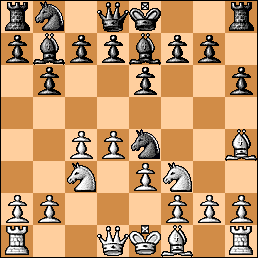
Thank you, young Grandmaster Bu, for re-introducing a Stone Age Saemisch Attacking Scheme in the Russian Team Championship, 2008! The common thinking was “White can’t mate like that, it’s ridiculous and will backfire.” Bu re-interprets it to say “Attila the Hun Genghis Khan sweeps through the Russian Steppes, killing everything he sees.”

[Event "TCh-RUS"]
[Site "Dagomys RUS"]
[Date "2008.04.02"]
[Round 1]
Bu Xiangzhi [2708] - Vadim Zvjaginsev [2674]
King’s Indian: Saemisch
[ECO "E83"]
[NIC "KI.52"]

1. d4 Nf6 2. c4 g6 3. Nc3 Bg7 4. e4 d6 5. f3 O-O 6. Nge2 a6 7. Be3 Nc6 8. Qd2 Bd7 9. h4 h5 10. Bh6!? TN? Refreshingly barbaric and a move I have been unable to locate in prior games. GM Miles played 10. O-O-O b5 11. Bh6 and Jadoul reacted incorrectly with 11…Kh7?, missing 11…Bxh6 12. Qxh6 e5! 13. d5 Na5! with good counterplay. Miles won that game easily in 29 moves, Miles-Jadoul, Brussels 1986. In our current game, Attila the Hun enters the hunt directly for the black king. The player facing Bu is no slouch, by the way. But note how quickly he is swamped.

Position after 10. Bh6!? - is this plausible move a Theoretical Novelty?

10...e5 The usual reaction is to draw the queen away with 10…Bxh6 11. Qxh6 and then hit in the center. In this exact position, 10…Bxh6 11. Qxh6 b5!? might be the way to go. Black will need nerves of steel, facing such scary lines as 12. O-O-O e5! 13. g4 bxc4 14. Ng3 exd4 15. Bxc4 Ne5!, but after all this is a kings of opposite castling game and every tempo matters. Bringing the white queen close to the black king looks insanely risky but sometimes it’s the right thing to do in order to make white’s central control weaker.

11. O-O-O b5 Once again, black disdains the stronger 11…Bxh6! 12. Qxh6 b5! and his counterplay is fast. As in the prior note, 13. g4 is met by 13…e5. Here’s another example of a defensive motif: 13. Nd5? bxc4 14. g4? Nxd5 15. exd5 Nb4! 16. gxh5 Nxa2+ 17. Kd2 Qf6! with an edge.

12. Nd5?! Incredibly primitive. Did Bu feast on red meat that day or look forward to a feast after the game? Black immediately goes wrong.

12…Re8? Weeeeeak. Correct was, yes, you’ve guessed it, the dangerous looking 12…Bxh6! 13. Qxh6 bxc4. Black has everything under control. See the prior note with how to handle the blunder 14. g4? and also note that 14. dxe5 Nxe5 15. Nef4 accomplishes nothing after 15…Rb8 where black’s play is more effective than white’s.

13. g4? The circumspect 13. Bg5! leads to a sharp game with mutual chances. The text is part of white’s crazed overall approach. The fact that this Paleozoic approach works is quite surprising given the level of strength of his opponent.

13…hxg4 14. h5 Nothing else to do but this shouldn’t work.

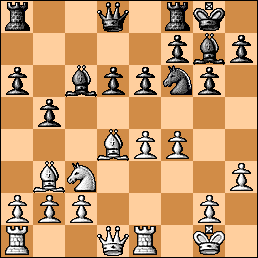
14…gxf3 15. hxg6 fxg6 16. Nec3 Was this bizarre formation white’s chief attacking idea? Black obviously is now totally confuzzled and commits a horrific blunder in a position where he has a simple win.

Position after 16. Nec3. Make or break time.

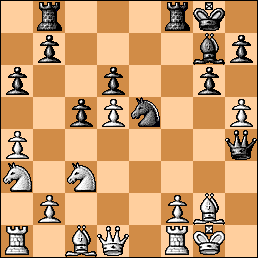
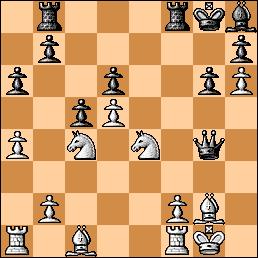
16…Nxd4??? A win to a loss in one unfortunate move. Black could have won the game here. The simple 16…Ng4! killed white’s attack. For example, 17. Bxg7 Kxg7 18. Bh3 (trying to get to the queen check on h6) Rh8! and black will win. Or, 17. Bg5 Qb8! 18. cxb5 Nxd4! with a big edge after, e.g., 19. bxa6 Be6 20. Rh4 Qa7. Lastly, 17. cxb5 axb5 changes nothing (18. Bg5 Qc8! 19. Nxb5 Be6! 20. Bc4 Na5! and black wins by one tempo). In addition, there is the humorous 18. Bg5 Qc8! 19. dxe5 Ncxe5 20. Ne7+ Rxe7 21. Bxe7 b4! and black wins by direct attack, e.g. 22. Nd5 Rxa2 23. Kb1 Qa8 and white can resign. In all variations, black’s king is safer than white’s now. I can’t resist here and will put a diagram after another humorous line, 17. cxb5 axb5 18. Bg5 Qc8! 19. Nxb5 Be6! 20. Nbxc7 Nxd4! 21. Kb1.

Position after 21. Kb1 (analysis).

As you can probably spot right away, the nice pseudo-queen sacrifice 21…Qxc7!! here wins. 22. Nxc7 Bxa2+ 23. Kc1 Nb3+ 24. Kc2 Nxd2 25. Kxd2 Nf2! and white has to resign.

17. Bxg7 Kxg7 18. Nxf6 Qxf6 19. Nd5 Everything with gain of time. Black was starting to feel sick, probably.

19…Qf8 20. Qh6+ Kf7 21. Qg5 Qg7 22. Rxd4! Obvious but nice. White systematically gets rid of all of black’s king defenders.

22…exd4 23. Qf4+ Bf5 24. exf5 g5 25. Qg4 Re1+ 26. Kd2 Rae8 27. Qh5+

What a massacre after black’s horrific 16th. Bu laid down the People’s Elbow.

1-0

An Unrelated Matter: Vicary-eseque Burberry’s Photos

Here are some Burberry’s photo ads outside the Burberry’s store in Michigan Avenue on Chicago. I think if I keep looking, I can construct a photo amalgamation of Elizabeth Vicary.

The Fabulous 00s: Some Chess Theory from the Tulsa US Championship Qualifier

April 18, 2008 by nezhmet

The March 2008 Tulsa, Oklahoma US Championship Qualifier had some interesting games from the perspective of chess theory. Let’s see some of these perpetual time pressure games (G/90 + 30 sec increment). Endings suffered, and opening familiarity rose to the foreground. See this background post for some Tulsa “glamor shots.”

GM Alex Yermolinksy - NM Movses Movsisyan, Round 2. Gruenfeld Defense.

1.d4 Nf6 2.c4 g6 3.Nc3 d5 4.cxd5 Nxd5 5.e4 Nxc3 6.bxc3 Bg7 7.Nf3 c5 8.Be3 cxd4 Here, 8…Qa5 and 8…O-O are the most popular. Strangely, black plays a burst of natural but rare moves and emerges with a good game!

9.cxd4 Bg4 9…Qa5+ 10. Qd2 Qxd2+ was a quick draw in Groszpeter-Farago, Bibinje 2006, but white has a small edge after 11. Kxd2 Nc6 12. Rb1 (12. Rc1 was played).

10.Be2 Nc6 11.d5 (What else?) 11…Ne5 12.Nxe5 Bxe2 13.Qxe2 Bxe5

Position after 13…Bxe5.

14.Rd1?! Previously, the lame 14. Qb5+? Qd7 led nowhere in Gorshkov-Zilberstein, Sverdlovsk 1979, and drawn in 30 moves. However, 14. Rc1! looks more useful than the artificial text move. After all, 14. Rc1! Qa5+ 15. Qd2 Qxd2+ 16. Kxd2 with f2-f4 coming is a solid ending edge for white.

14…Qa5+ 15.Bd2 Qa4! With simple moves, black has achieved a good game against the experienced grandmaster. Note that Yermo provided several good wins of his vs. the Gruenfeld in his book “The Road to Chess Improvement.” This indicates that black’s particular Gruenfeld choice in this game warrants further study. Well, maybe not, since white did have the stronger 14. Rc1! in the game.

16.Bh6 Qb4+ After 16…Rc8 17. O-O Rc2, black has full equality. For example, 18. Qd3 Rxa2 19. Rc1 Ra3 20. Qe2 Ra2 21. Qf3 Ra3 is a perpetual attack on the queen and draw.

17.Kf1 Rc8 18.g3 Rc4 19.Re1 Bc3 19…Qa4! eyeing c2 is strong. Then, 20. Kg2 f6 makes an escape hatch for black’s king and once again he is happy.

20.Rc1 Rxe4?? Black ruins everything with a dreadful tactical oversight. 20…b5 was fine. For example, 21. f3 Be5 22. Kf2 Kd7! with equality.

21.Qc2 Rc4 22.Bg7! Oops. Undoubtedly overlooked by black. The rest of the game is technique.

22…Bxg7 23.Qxc4 Qxc4 24.Rxc4 Kd7 25.f4 b5 26.Rc6 Rb8 27.Ke2 b4 28.Ra6 Rb7 29.Rb1 Bc3 30.Kd3 Rc7 31.Rc1 Rc5 32.Rxa7+ Kd6 33.Ke2 33. a3 is a simple win. 33…Rxd5+ 34. Kc4! Rd4+ 35. Kb3 Rd3 36. axb4! Bd4+ 37. Kc4! does the trick. The text is fine too. White will win this.

33…Rxd5 34.Rd1 Rxd1 35.Kxd1 Bd4 36.Rb7 Bc5 37.Ke2 Kc6 38.Rb8 Kd5 39.Kd3 e5 40.fxe5 Kxe5 41.Rb7 Ke6 42.g4 Bd6 43.h3 h6 44.Ke4 f5+ 45.gxf5 gxf5+ 46.Kf3 Be7 47.Rb8 Kf6 48.Rg8 Bd6 49.h4! Iron-clad. 49…Kf7 50.Rg2 Be7 51.h5 Bg5 52.Rc2 Ke6 53.Rc6 Kd5 54.Rb6 Kc5 55.Rg6 Bd2 56.Ke2 Bc1 57.Rf6 Kb5 58.Rxf5 Ka4 59.Kd3 Bb2 60.Kc4 Bc3 61.Rd5 Ka3 62.Rd6 Kxa2 63.Rxh6 Bd2 64.Rd6 Bc3 65.h6 Kb2 66.h7 Kc2 67.Rh6 Bh8 68.Kxb4 Kd3 69.Re6 1-0

IM Blas Lugo - GM Jesse Kraai Round 4, French Exchange


1.e4 e6 2.d4 d5 3.Nc3 Nf6 4.Bg5 dxe4!? 5.Nxe4 Be7
A favorite treatment of GM Evgeny Bareev. This is not as quiet as it appears since the kings wind up on opposite sides often. It has the advantage of avoiding many long mainline theory variations.

6.Bxf6 Bxf6 7.Nf3 Nd7

Position after 7….Nd7. Decision Time.

8.Qd2 Maybe it’s just me, but I think a planned Bishop placement on d3 warrants a queen on e2 more than a queen on d2. For example, 8. Bd3 O-O 9. Qe2 c5!? 10. O-O-O cxd4 11. h4!? with ultra sharp play (eventually drawn) in Sutovsky-Ivanchuk, Moscow 2002. Both this plan and the text have been seen in dozens of games, of course.

8…O-O 9.O-O-O Be7 10.Bd3 b6 11.Kb1 The primitive 11. h4 turned out to be too slow in Suetin-Bareev, Hastings 1991, and black won after 11…Bb7 12 Kb1 Nf6. To give a counter-example, White won after 11. h4 Bb7 12. c3!? Nf6 13. Neg5 Bxf3 14. gxf3, but this position is equal after 14…Qd5. Black played 14…Kh8?! and lost in Topalov-Dreev, Linares 1995. The text move, on the other hand, also doesn’t promise much - only 3 draws in Chessbase’s BigBase. A more dangerous try is 11. Neg5!? which hopes for 11…h6? — after 11. Neg5 h6?, white scored +4 =0 -0 in ChessBase!

Position after 11. Neg5!? (Analysis). Black has to be careful.

But there’s a curiosity here: in Volokitin-P.H. Nielsen, Germany 2004, the game went 11. Neg5 h6 12. Bh7+ Kh8 13. Be4 which at first glance looks good for white. However, upon reflection doesn’t it look like black missed 13…hxg5 14. Bxa8 g4! and the threat of Be7-g5 wins material? We will come back to this. In the game, black played 13…Bxg5 14. Nxg5 Rb8 and lost. However, he was doing OK after 15. Nf3 Nf6 16. Bc6 Qd6 17. Ne5 Ng4! 18. Nxg4 Qc6 - he only lost due to later middlegame miscues. The truth about 13…hxg5? is revealed in another example, J. Polgar - F. Berkes, Budapest 2003, white introduced an incredible gambit: 12. Bh7+ Kh8 13. Be4 hxg5? 14. g4!! (not the greedy 14. Bxa8?) and now black faces complex problems. White stops black from playing g5-g4 and prepares to open the h-file. In the game, black lost after 14…Rb8 15. h4 g6 16. hxg5+ Kg7 17. Qf4 and white crashed through. The question is, can black live after 14. g4? Let’s take a look. First of all, 14….Ba6 15. h4! gxh4 16. g5! is crushing. For example, 16…Kg8 17. Rxh4 f5 (What else?) 18. Bc6 Rc8 19. Rdh1 Kf7 20. d5! and wins. Let’s go back to Berkes’s choice, 14…Rb8. 15. h4 and first we see that 15…gxh4? is bad: 16. g5 g6 17. Rxh4+ Kg7 18. Rdh1 Rg8 19. Rh7+ Kf8 20. Qf4! and wins.

So we go to Berkes choice, 15…g6 16. hxg5+ Kg7 17. Qf4. This is critical. We first notice that 17…Ba6 is crushed by a typical Judit Polgar brute-force tactic 18. Rh7+!! Kxh7 19. Qh2+ Kg8 20. Rh1 Bxg5+ 21. Nxg5 Qxg5+ 22. f4! and wins. We also notice that Berkes’s choice, 17…Bb7?, was crushed by the same tactic.

what about 17…Rh8!? - trying to defend on the h-file. There follows 18. Rxh8 Qxh8 (forced) 19. Ne5! and now black cannot take: 19…Nxe5? 20. Qxe5+ Kg8 21. Qxc7 Bxg5+ 22. Kb1 and the rook on b8 is trapped; white wins. And after 19…Qe8 20. Rh1! the lethal threat of 21. Nxf7! is introduced. Black still cannot take on e5 and hence is lost.

Going back to the beginning, 11. Neg5!? is best met by 11…Bxg5! and now 12. Qxg5 Qxg5+ 13. Nxg5 Nf6 is dead equal. Or, 12. Nxg5 Nf6 and black is OK and even won in B. Lopez-Kraai, San Diego 2004. That game continued 13. Qf4 Bb7 14. Rhe1 Qd6!? and here white disdained an equal ending after 15. Qxd6, opting for 15. Qh4 h6 16. Nf3 (16. Ne4! equal) Bxf3 17. gxf3 Nd5 18. Re4, eventually getting into trouble with the weak d4 pawn. White tried 13. h4!? in Sax-Dizdar, Celje 2003, and black reacted suspiciously with 13…c5?! 14. dxc5 Qd5 15. Kb1? Qxc5 equal. But white missed 15. Qf4!! Qxa2 16. Nxh7! Nxh7 17. Qe4 Nf6 18. Qxa8 Qa1+ 19. Kd2 Qxb2 20. Qxa7 and white keeps a small plus. Stronger is 13. h4 Bb7! and black is fine.

11…Bb7 12.Qf4 c5 In Sindik-Dizdar, Pula 1993, black introduced an idea similar to the game a little earlier: 12…Qb8!? 13. Qg3 c5! with good play. White can improve with 13. Ne5! c5 14. Bb5! Nf6 with sharp play after 15. Nxf6+ Bxf6 16. Rhe1 and now the Korchnoi pawn grab 16…Bxg2!?

13.dxc5 Qb8! Gambits in opposite-castled king positions are effective even in the ending! This is particularly true in the “perpetual time pressure” time control of G/90+30 sec. This motif, although it has been seen before, is ingenious and disconcerting for white. There is no more attack and white has to switch gears (notoriously difficult) to a defensive up-a-pawn but under pressure mode.

Position after 13….Qb8! - A gambit to reach an ending!

14.Qxb8 Raxb8 15.cxb6 Nxb6 16.b3? Correct is the solid but not particularly easy to find 16. Ned2! and then a defensive hunkering down. This would not create the glaring c3 weakness in the game. White would then have enough counter-chances.

16…Na4! Very unpleasant to meet in this time control. White probably overlooked this. The c3 square is now home for black’s knight.

17.Rde1 Bxe4 18.Bxe4 Nc3+ 19.Kb2 Bf6 This position is terrible for white.

20.Bd3 Ne4 21.Kb1 Nxf2 22.Rhf1 Nxd3 23.cxd3 Rfd8 24.Re3 a5 25.Ne5 Rd5? Correct is 25…Bxe5 26. Rxe5 a4! and black is on top. For example, 27. Kc2 axb3+ 28. axb3 Ra8 29. Kc3 Ra2 with a huge initiative.

26.Nc6 Rb7 27.Rg3 Kf8 28.Rf4! White is doing the right things now to get back in the game.

28...Be5 29.Nxe5 Rxe5 30.Rc4 f5 31.Rf3? 31. Kc1!

31…Ke7 31…Re2! is strong. 32.Rf2 Rd7 33.Kc2 Red5 34.Rf3 Kf6 35.Kc3 g5 36.d4? 36. h4! to reduce the number of pawns.

36…f4 37.a3 Kf5 Now black is gaining control again with his monstrously active king.

38.Rc5? White had to wait with 38. Rf2. The pseudo-active text is crushed.

38…g4 39.Rf1 e5! White probably underestimated this.

40.Rxd5 Rxd5 41.dxe5 Rxe5 42.Kd2 h5 43.b4 axb4 44.axb4 h4 45.Rb1 f3 46.gxf3 gxf3 47.b5 Kg4! The key move. White is lost.

48.b6 f2 49.b7 Re8 50.Rb4+ Kh3 51.Rb3 Kg2 52.b8Q Rxb8 53.Rxb8 f1Q 54.Re8 0-1

In more Round 4 action:

GM John Fedorowicz - FM Michael Langer Modern Benoni

1.d4 Nf6 2.c4 c5 3.d5 e6 4.Nc3 exd5 5.cxd5 d6 6.Nf3 g6 7.Nd2 Nbd7 8.e4 Bg7 9.Be2 O-O 10.O-O Re8 11.a4 Ne5 12.Qc2 g5 13.Ra3 Fischer defeated the lame 13. Nf3?! Nxf3+ 14. Bxf3 h6 in Gligoric-Fischer, Palma de Mallorca 1970 Interzonal. White has equality here but Gligoric soon made a fatal tactical miscue. The text move is an idea of Petrosian’s; but will it “work” along the 3rd rank or get stuck?

Position after 13. Ra3. How useful will this rook be?

13…g4 14.Nd1 Ng6!? The very interesting 14…Nh5!? was seen in Antunac-Y. Gruenfeld, New York 1981, and black managed to win eventually. The game proceeded 15. Ne3 Nf4 16. Bd1 and black was very active. If 15. Re1 Nf4 16. Bf1 Neg6 and black is also OK and drew in 23 moves, Karolyi-Poloch, Leipzip 1984. The most active move, 15. f4!?, might be good for white but prior games misplayed both sides: 15…gxf3 16. Nxf3 Ng6?! 17. Ng5? (17. Bg5! with edge) and drawn eventually, Koualty-Renet Marseille 1988. Or 16…Nxf3+ 17. Bxf3 (17. Raxf3 is a white edge) 17…Be5?? 18. g3?? and white even lost in 40 moves, Nowak-Pokojowczyk Zielona Gora 1982. Black’s 17th move was complete bluff and white could win with the very nice 18. Bxh5 Qh4 19. Rg3+! (Ouch!) 19…Bxg3 20. Bxf7+ Kg7 21. hxg3 Qxe4 22. Bh6+!! Kxh6 23. Qc1+! Kg7 24. Qg5+ and now black must lose his queen with the sad 24…Qg6 - so it’s resignable.

Tentative Conclusion: 15. f4! is the best move after 14…Nh5!?

The natural move 14…Bd7!? is also very interesting. White gets in trouble after the lemon 15. Bb5? Bxb5 16. axb5 Qb6!. No edge for white is to be seen in this position. After the text move, black has enough counter-chances as well.

15.Ne3

Position after 15. Ne3.

15…Qe7?! 15…Nf4! is a good choice. Witness the nifty defusing tactic: 16. Bb5 Bd7! 17. Bxd7 (apparently gaining the monster square f5 for the knight) 17…Ne2+!! 18. Kh1 Qxd7 19. Nf5 Nd4! with equality. A very nice defensive motif. There is also 16. Bc4 and here is a crazy repetition draw line: 16. Bc4 Bd7 17. f3!? gxf3 18. Rxf3 Bh6 19. Kh1 Bg5 20. Rg3 N6h5 21. Rf3 Nf6 22. Rg3. Unforced, but you get the idea. Putting the queen opposite the white rook (soon to arrive on e1) will have nasty consequences in the game.

16.Bb5 Rd8 17.a5 Not much is accomplished by 17. f4 gxf3 18. Rxf3 a6 19. Bd3 Ne5 with equality.

17…Nf4 17…a6 is possible. If 18. Ba4 Nf4 19. Re1 with a small white edge.

18.Re1 h5 19.Qd1 h4? Again, the careful 19….a6 is good to include. For example, 20. Bf1 Re8 and all is well. More dangerous is 20. Ba4! Rb8 21. Bc2! with a latent attack in the works. The impulsive text is an example of going overboard in a Modern Benoni. Just because the opening is an active choice does not mean every single move has to be maximally active even at the cost of weakening.

20.Nf5! The punishment. Black’s king is too weak now.

20…Bxf5 21.exf5 Qf8 22.Ne4 N4xd5 23.Bg5 Note that 23. a6! is crushing.

23…Nxe4 24.Rxe4 Nf6 25.Bxf6 25. Re1 with the idea of Bxh4 would win easily also.

25…Bxf6 26.Rxg4+ Kh7 27.Qd5 Black is paralyzed.

27…Qe7 28.Re3 Qc7 29.Rxh4+ 29. Qe4 with the idea of 30. Rxh4+ was total butchery. The text also wins quickly.

29…Bxh4 30.f6 Kg6 31.Re7? 31. Bd3+ is a fast forced mate. 31…Kxf6 32. Qf5+ Kg7 33. Qh7+ Kf6 34. Qh6 mate. Accuracy is often a victim at this crazy time control (or maybe white was playing on black’s clock). Of course, the text wins easily as well.

31…Qxe7 32.fxe7 Bxe7 33.Bc4 Rf8 34.Qe4 Kf6 35.Qh4 Ke5 36.Qxe7 Kd4 37.Bf1 1-0

Let’s move on to a real barn burner between two strong Grandmasters.

Round 5. GM Goldin - GM Yermolinsky Slav Defense

1.d4 d5 2.c4 c6 3.Nf3 Nf6 4.e3 Bf5 5.Nc3 e6 6.Nh4 Be4 7.f3 Bg6 8.Qb3 Qc7

Position after 8…Qc7. To 9. g4 or not to 9. g4.

9.Bd2 GM Vadim Milov, a connoisseur of opening theory, played 9. g4!? here and won after 9…Be7 10. g5!? Nfd7 (10…dxc4!) 11. Nxg6 hxg6 12. f4 f6? (12…dxc4!) 13. Bd2 with a big edge; Milov-Rogozenko, Istanbul 2000. If black had played the correct dxc4! on either move 10 or move 12, he would have had equal chances. Goldin’s natural move has also been seen.

9…Be7 10.Nxg6 Karpov got nowhere with 10. g3 Bh5! and drawn in 31 moves, Karpov-Bacrot Cannes 2000. 10. cxd5!? looks stronger. After 10…cxd5 11. Nxg6 hxg6 12. Bd3 Nc6 13. O-O-O, black missed the mirror move 13…O-O-O! and lapsed with 13…a6, going on to lose in Malakhov-Volkov, Sochi 2004.

10…hxg6

Position after 10…hxg6. A very critical moment. To cackle or not to cackle?

11.Rc1 This is an important moment. Van Wely was successful twice (vs. Volkov and Sokolov) with 11. O-O-O! here. For example, 11. O-O-O Nbd7 12. cxd5! Nxd5 13. Kb1 Nxc3+ 14. Bxc3 and white is clearly better (Van Wely-Sokolov, Amsterdam 2002, and 1-0, 55 moves. Or, 11. O-O-O a6 12. Kb1 dxc4 13. Bxc4 b5 14. Bd3 Rxh2 and here, 15. Ne4! is strong with white advantage (15. g4?! was played, but white won a long game anyway, Van Wely-Volkov, Panormo 2002, 1-0, 79). After 11. O-O-O, 11…dxc4!? looks critical. 12. Bxc4 b5 13. Be2!? a6 14. Kb1?! was Tregubov-Bareev, and black won a tough struggle, 0-1 40 moves, Venacu 2006. It’s easy to find improvements for white. First of all, in the game, 14. e4! is strong (14…Rxh2? 15. e5! with a big edge). Secondly, the more active 13. Bd3!? (with Nc3-e4 ideas) is a tricky try one move earlier. Black’s position is very dangerous after 13…Rxh2 14. Qc2!. Conclusion: 11. O-O-O! is strong!

11…Nbd7 12.cxd5 exd5 12…Nxd5! is fine for black. For example, 13. e4 Nxc3 14. bxc3 Bh4+! (the point!) and black is happy.

13.e4 13. g3 Bd6 got white nowhere in Chiburdanidze-Zhukova, Istanbul 2000, and drawn in 16 moves.

13…dxe4 14.fxe4 Rxh2 14….Rd8! is perfectly good for black. The text is OK too but chances are still balanced. We are now out of book and it’s …. about even.

15.Rxh2 Qxh2 16.Qxb7 The computer move 16. e5 is playable. One humorous line is 16…Nxe5!? 17. dxe5 Qxe5+ 18. Kd1 Rd8 19. Qxb7?? Qf4! and wins.

16…Rb8 17.Qxc6 Rxb2 18.Nb5 Qh4+ 19.Kd1 Qf2

Position after 19…Qf2. White falls on his own Claymore.

20.Qa8+?? A horrific blunder that loses on the spot. 20. Qc8+! is drawn. For example, 20…Bd8 21. Be2 Qg1+ 22. Be1 Qe3 (or 22…Nxe4 23. Nc7+ Ke7 24. Nd5+ with a perpetual check) 23. Rc2! (guarded by the queen!) Rb1+ 24. Rc1 Rb2 25. Rc2 with a repetition. White must have missed something very simple.

20…Bd8 21.Be2 Qg1 22.Be1 Qxg2 Oops. There is no 23. Rc2 defense because the white queen is on a8, not c8. So white could already resign.

23.Bd2 Qg1 24.Be1 Qe3 25.Rc8 25. Nc7+ Ke7 is just a spite check.

25…Qxe2+ 26.Kc1 White has seen enough and resigns before black can play 26…Rxb5. An unusual collapse on Goldin’s part.

0-1

Here’s an important last round game - the winner qualified for the US Championship (to be held also in Tulsa). Once again the Gruenfeld triumphed.

IM Salvijus Bercys - GM John Fedorowicz Round 7, Gruenfeld Defense

1.d4 Nf6 2.c4 g6 3.Nc3 d5 4.cxd5 Nxd5 5.e4 Nxc3 6.bxc3 Bg7 7.Nf3 c5 8.Be3 Qa5 For 8…cxd4, see Yermolinsky-Movsisyan discussed above.

9.Qd2 O-O 10.Rc1 The most popular, but 10. Rb1 is a major alternative. Statistically, 10. Rb1 scores a little better.

10…Rd8 11.d5 e6 12.c4 Qxd2 13.Nxd2 b6 14.Be2 Na6 15.O-O GM Khenkin is a proponent of the weird 15. Nb1!?. After 15. Nb1 f5 16. f3 fxe4 17. fxe4 Bb2 18. Rd1 exd5 19. cxd5 Re8 the chances were balanced and the game was drawn in 24 moves, Khenkin-Gutman Bad Wiessee 2002.

15…Nb4 Still the mainline, we are following 18 games in ChessBase. Nevertheless, the position appears to promise zero for white so it’s a mystery why it has occurred so often.

16.a3 Na2 Black’s knight wanderings are actually very logical. White has proven nothing in practice starting from this point.

Position after 16…Na2. White has nothing.

17.Rc2 Nc3 18.Bd3 White plays a slightly less common move now. The most common move is the awkward looking 18. Bf3. However, black won after 18. Bf3 exd5 19. cxd5?? (19. exd5! Bf5 20. Rcc1 equal) 19…Ba6 20. Rfc1 Ne2+ 21. Bxe2 Bxe2 22. f3 Bd3 with an obvious advantage, R. Stone - Ilya Gurevich, Chicago 1992.

18…Ba6 19.Bg5 Some white players have preferred 19. Nb1? here, but it’s just a blunder after 19…exd5 20. Nxc3 d4 with a big black edge after 21. Nd5 dxe3 22. fxe3 Be5.

Position after 19. Bg5. Time for a surprise!

19…exd5!? TN I have not been able to locate this move, hence I am labeling it a Theoretical Novelty (TN). Previously seen was 19…Rd7!? and black has quite a good game. For example, 19…Rd7 20. Rfc1 h6 21. Bf4 exd5 22. Rxc3 Bxc3 23. Rxc3 g5 24. Bg3 dxc4 25. Nxc4 Rd4 26. Bf1 Rad8 27. f4?? Rxe4 and black went on to win, Tunik - Timofeev, St. Petersburg 2002. 27. f3! of course was correct with an equal game. The conclusion is that the entire line is harmless. White has to seek improvements earlier.

At this point, according to Monroi, black had spent 1 minute and 30 seconds executing all these moves! The sacrifice is made even more attractive by the fact black is not risking anything. His position is very solid after white grabs the exchange with the bishop pair and an extra pawn.

20.Bxd8 White, surprised, took 8 minutes on this and now had 1:02 remaining.

20…Rxd8 21.exd5 Nxd5 22.Re1 Nf4 23.Bf1? Passive. White only spent one minute on this clunker. 23. Be4! is clearly stronger. White is in no danger after 23…Ne6 24. Nf3 Bf6 25. g3. Or, 23…Nd3? 24. Bxd3 Rxd3 25. Re8+ and white is too active.

23…Ne6 24.Nb3 Weird. 24. Nf3 is more natural.

24…Bb7 25.a4?! White’s moves are all connected to a poor plan of queenside action. He could have still bailed out with 25. Rd2 and a likely draw.

25…a5 26.Ra2 Bc3 27.Rc1 Bb4 28.f3?! 28. Be2, guarding d1 and contemplating Rd1, looks better.

28…Bc6 29.Kf2 Kg7 30.Be2 Nd4 31.Nxd4 cxd4 32.Bd3 Re8 33.Be4? This move, losing a key pawn, is too cavalier and should just lose. Most players would just wait. However, black reacts inaccurately to give white one more chance on move 40.

33…Bxe4 34.fxe4 Rxe4 35.Rd1 Bc5 36.Rd3 f5 37.Re2 Kf6?! The clever 37….g5! is stronger here to rule out the white possibility mentioned in the note to white’s 40th move.

38.h3 h5?! And here, black had 38…Rf4+ and a later …g5, or 38…g5 right away. The idea is to take away h3-h4 for white.

39.Kf3 Ke5

Position after 39…Ke5. Last Chance.

40.Rd1? The last chance to resist was 40. h4! to hold black up on the kingside. White might even be able to hold the position with careful play; it’s up to black to demonstrate progress.

40…g5! Now it’s really all over. The rest is torture.

41.Rd3 Bb4 42.Rd1 Bc5 43.Rd3 g4+ 44.Kf2 h4 45.Kf1 Bb4 46.Rd1 Rxe2?! The simplest is 46… gxh3 47. gxh3 f4 with total domination.

47.Kxe2 Ke4 48.Rf1? Very bad. White has to try to hold the 3rd rank with 48. Rd3 and make black demonstrate a plan.

48…d3+ 49.Kd1 gxh3 50.gxh3 f4 51.Rg1 f3 52.Rg6 f2 53.Rf6 Bc5 White is paralyzed and gives up.

0-1

The Fabulous 80s: The Inimitable Kamran Shirazi

April 7, 2008 by nezhmet

Iranian International Master Kamran Shirazi was a fixture on the NY Chess Scene in the 1980s and a dashing, enigmatic, figure. From Wikipedia, “He was known for playing strange and unorthodox openings. As this was a period of rating inflation, Shirazi’s rating rose rapidly and he became one of the highest rated players in the United States Chess Federation. However, when invited to play in the 1984 U.S. Chess Championship, Shirazi managed only one draw from 17 games, finishing last.[3] In that championship, Shirazi also achieved the dubious distinction of losing the shortest decisive game in the history of the U.S. Championship: his game as White against John Peters, which went 1.e4 c5 2.b4 cxb4 3.a3 d5 4.exd5 Qxd5 5.axb4?? Qe5+ 0-1.”

The Bar Point Details

I can add some details probably unknown to Wikipedia: in the early 1980s, a number of us crazy chess players slept over at the Bar Point chess club (14th Street and 6th Avenue in New York City) quite a bit. It was owned at one point by card player Peter Malick and at another point by Bill Goichberg. It started life as a backgammon club owned by err… a backgammon player - readers, need help here. We loved the sandwiches made by sandwich ladies Diana Lanni and Judy Shipman. The night-time denizen roster was strong: me, Jon Tisdall, Michael Rohde, and future poker great Howie Lederer. One night Shirazi showed up into our large, common, sleeping room known as the “Cloud Room.” I think it was called this because of the decrepit oversized pillows issued billowing clouds of dust creating “clouds” when they were moved around on the foam sofas. Shirazi enters the Cloud Room and announces “I am divorcing.” Tisdall hugs one particular pillow and says “You’re not getting my pillow.” I would categorize this as typical chess player banter. Shirazi was impressive in 1980’s tournaments with the ladies’ pick-up line: “Just Hold Me.” This line works. Fortunately his rating inflation led to my own because I defeated him numerous times in the 1980’s and 1990s, amassing a large plus record. The trick was to stay alert and not fall for some crazy Shirazi tactic. Many players were unable to do this (even strong ones) and succumbed to his strange play. One of his trademarks that you will see in the games below are wild, seemingly amateurish (OK, often amateurish) pawn lunges and strange minor piece formations.

Shirazi vs. Zuckerman

A typical dialog overheard at the Manhattan Chess Club Championship: Shirazi: “I am an artiste… I move the chess pieces… trying to create art….” Bernard Zuckerman (representing science and rationality): “I have no idea what you are talking about.” Well, let’s put some 1980s Shirazi games before the viewing public and let them make up their own minds.

On to the Chess!

Game 1. Kamran takes on a “rock”, GM Anatoly Lein.

Shirazi - Lein, US Championship 1986 French Winawer 4. Ne2 variation

1.e4 e6 2.d4 d5 3.Nc3 Bb4 4.Ne2 dxe4 5.a3 Be7 6.Nxe4 Nd7 7.Bf4 Ngf6 8.Qd3 A rather common sideline of the set of Winawer uncommon sidelines. Black is not supposed to have problems, but look what happens to the veteran!

9…O-O 9.O-O-O b6 10.Nxf6+ Nxf6 11.Qg3? The game continuation is just good for black.

11…Ne4! 12.Qe3 Bb7 13.f3 Nf6 14.Be5 Qd7? A boo-boo in return. The simple 14…Nd5 15. Qd3 Bg5+! 16. Kb1 a5! is very good for black as is 16. f4 Bh6! 17. c4 f6! - in both cases black has a strong initiative and Shirazi did not like to defend.

15.Kb1 Rac8 16.Nc3 a6? Bizarre and slow. 16…Nd5 is completely fine for black.

17.Bd3 b5 18.g4 The lunge 18. Qg5! is objectively stronger here.

18…Nd5 19.Nxd5 Bxd5 20.g5 Bd6 This instructive sequence builds a defense: 20…a5! 21. Qf4 Bd6 22. Rhg1 g6! 23. Rg3 Bxe5 24. dxe5 b4 25. Qh4 bxa3 26. Rh3 h5! 27. gxh6 Qd8! and black is fine.

21.Rhg1 c5?! And now black is really asking for it. He had the simple 21…Bxe5 22. dxe5 Rfd8 23. Rg3 c5! 24. Rh3 g6 25. Qf2 Qe7 and black is solid.

22.Rg3 c4? Now the situation demands the utmost care. He needed to play 22…cxd4! and now the sacrifice fails: 23. Bxh7+? Kxh7 24. Rh3+ Kg8 25. Qd3 f5! 26. gxf6 Bxe5 27. Qh7+ Kf7 28. Qxg7+ Ke8 29. Qxf8+ Kxf8 30. Rh8+ Kf7 31. Rh7+ Kxf6 32. Rxd7 Rg8 and by the immutable laws of Sturm und Drang, black winds up winning the ending. If white plays the superior 23. Qxd4 Bxe5 24. Qxe5 Rfd8 25. Rh3 g6 26. f4 Qc5 28. Ree3, trying to mate via the Rxh7 trick (see Game 6 for this failed motif re-occurring), black has the cold shower move 28…Bg2! guarding h3, getting the queens off, and reaching an equal ending. By the text move, Black was hoping he was showing incredible sangfroid. But it’s tactical short-sightedness as White is tempted into a winning sacrificial adventure.

Position after 19...c4

Position after 22…c4 - time to pull the trigger!

23.Bxh7+! The conditions are right!

23...Kxh7 24.Rh3+ Kg6 24…Kh8 is crushed by 25. Qf4 Bxe5 26. Qh4! f6 27. g6 and mate.

25.Rg1 Rg8 26.Qf4 White is lining up for some very nasty mates, some of which involve a queen sacrifice.

26…Bxe5 27.dxe5 Qe7 28.Qg4 c3 29.Rh4! Completing the entombment of black’s king.

Position after 29. Rh4. Resignation is forced.

The problem is that 29…Rh8 30. Rh6+! mates. 1-0

Now he takes on “Joe Solid”, aka “Mr. Trading Queens” or “Mr. Endgame”, Maxim Dlugy, in the 1985 US Championship. Evidently, there was no hangover from the 1/2 out of 17 score in the prior year’s version (in Berkeley - alarm bells, anyone?). Note to future US Championship organizers: 17 games is too long an event. In this perplexing game, Maxim does succeed in getting the queens off but Kamran confounds with unusual piece placements and pawn lunges.

Game 2. Shirazi - Dlugy, US Championship 1985 Caro-Kann 1.e4 c6 2.d4 d5 3.Nc3 dxe4 4.Nxe4 Nd7 5.Bc4 Ngf6 6.Ng5 e6 7.Qe2 Nb6 8.Bd3 h6 9.N5f3 c5 10.dxc5 Bxc5 11.Ne5 Nbd7 12.Ngf3 Nxe5 13.Nxe5 O-O 14.Bd2 Qd5 15.f4 b5 16.Be3 Bxe3 17.Qxe3 Bb7 18.Rg1 Rfd8 19.g4 Qd4 20.Qxd4 Rxd4 21.g5 hxg5 22.fxg5 Nh5 23.O-O-O Rd5 24.Rge1 Nf4 25.Bf1 a6 26.c4 Rc8 27.b3 f6 28.gxf6 gxf6 29.Nd7 Rxd1+ 30.Rxd1 f5 31.Rd4 Ng6 32.Kb2 b4 33.c5 Rc7 34.Bc4 Kf7 35.Rd6 Nf4 36.c6 Bc8 37.Rd4 Ng6 38.Nb8+ a5 39.Bb5 e5 40.Rd1 e4 41.h4! White’s perplexing play all over the board nets material shortly.

41…f4 42.h5 Ne5 43.Nd7 Nxc6 44.Bxc6 e3 45.Bd5+ Kg7 46.Rg1+ Kh6 47.Nf6 Bf5 48.Ng8+ Kxh5 49.Bf3+ Kh4 50.Rg2 Bh3 51.Rg1 Rd7 52.Kc1 Bf5 53.Nh6 Be6 54.Rg6 Bd5 55.Nf5+ Kh3 56.Rh6 mate. 1-0

Here is Kamran laying some hurt on many-time US Champ Lev Alburt when Lev incautiously avoids a draw by perpetual.

Game 3. Lev Alburt - Kamran G Shirazi 1983 US Championship Benoni Defense 1.d4 c5 2.d5 Nf6 3.Nc3 g6 4.e4 d6 5.Nf3 Bg7 6.Be2 O-O 7.O-O Na6 8.Nd2 Nc7 9.a4 e6 10.Nc4 exd5 11.exd5 b6 12.Bf4 Ba6 13.b3? Correct is 13. Qd3 with an edge. On the other hand, the capture orgy variation with 13. Bxd6 Bxc4 14. Bxc7 Bxe2 15. Bxd8 Bxd1 16. Bxf6 Bxc2 17. Bxg7 Kxg7 is dead equal. The text is a simple tactical oversight and indicative of Lev’s poor form in this game (see his blunder on move 20).

Position after 12. b3? - Black misses a tactical resource.

13…Re8? An amusing reciprocal blunder. Black had the obvious 13…Nfxd5 with a huge edge. The point is that 14. Nxd5 Nxd5 15. Qxd5 (if 15. Bxd6 Nc3! wins) 15…Bxa1 16. Rxa1? Qf6! is a double attack that wins for black. Even the better 16. Nxd6 Bxe2 17. Rxa1 Qf6 18. Be5 Qe6 should win for black. After the text, it’s equal.

14.Bf3 Nh5 15.Bd2 Bxc4 16.bxc4 Qh4 17.Be2 Be5 18.g3 Nxg3 19.hxg3 Bxg3 Naturally it should be a perpetual check draw now when white grabs the bishop.

Position after 19…Bxg3: Time for a rare Alburt miscue.

20.Kg2?? An irrational misjudgment exposed in only 2 moves, but this happens to the best of us. For Lev Alburt, this sort of grotesque blunder was indeed very rare in the 80s - he had great tournament results in the U.S.

20…Qh2+ 21.Kf3 Bxf2! Oops! The flaw is exposed. 22. Rxf2 Qh3+ 23. Kf4 is suicide: 23…Re5 threatening …g5 mate; if then 24. Rg2 Rf5+ 25. Ke4 Re8 mate is an ignominious checkmate in the middle of the board. Another plausible defense, 22. Bf4, is crushed by the aesthetic 22…Re3+!! 23. Bxe3 Qg3+ 24. Ke4 Qxe3 mate. Maybe it was this latter variation that Lev overlooked.

22.Rg1 Re5 23.Bd3 Bxg1 24.Ne4 Of course 24. Qxg1 Qxd2 is hopeless.

24…Rf5+ And mate next move. 0-1

The next game shows Shirazi’s astounding versatility in the opening - a staid Petroff Defense eventually becomes a barn-burning back-rank mate motif!

Game 4. [White "Nick DeFirmian"] [Black "Kamran G Shirazi"] US Championship 1986 Petroff Defense

1.e4 e5 2.Nf3 Nf6 3.Nxe5 d6 4.Nf3 Nxe4 5.d4 d5 6.Bd3 Bd6 7.O-O O-O 8.c4 c6 9.Nc3 Nxc3 10.bxc3 Bg4 11.Rb1 dxc4 12.Bxc4 b5 13.Bd3 Nd7 14.h3 Bh5 15.Be4 Qc7? A bizarre blunder. After the obvious 15…Rc8 16. Qd3 Nf6 17. Bf5 Bg6 black is OK.

16.Bxh7+! Did Kamran overlook this simple tactic? He plays on as if nothing has happened. His games often feature huge swings so my advice to any prospective opponent is, don’t relax after gaining a huge edge with an obvious tactic.

16…Kh8 17.Bd3 17. Bf5 followed by g2-g4 is crushing. 17. Bc2 is very strong too, for example 17. Bc2 Rae8 18. g4 Bg6 19. Bxg6 fxg6 20. Qd3 and black is in very bad shape. If 17. Bc2 f5 18. Re1 black is lost due to the new weakness on f5.

17...f5 18.Be2?! 18 Re1 is stronger.

18…Rae8 19.Re1 Nf6 And now, for reasons unknown, white not only fails to convert the material but he goes on to lose in a rather disorderly manner. I suspect the clock was a factor.

20.Ng5 The solid 20. Be3 Ne4 21. Qc2 maintains white’s edge.

20…Bh2+ 21.Kh1 21. Kf1 is stronger.

21… Rxe2 22.Rxe2 Ne4? A blunder. 22…Bxe2 was compulsory.

23.Nxe4 fxe4 24.Qe1? White might have been low on time already. 24. Ba3! Rxf2 25. g4!! wins cleanly. It is counter-intuitive to move pawns in front of one’s own king but in this case it simply gains massive amounts of material while simplifying. For example, 25…Qg3 26. Rxf2 Qxf2 27. Rb2! and black must resign.

24…Bxe2 25.Qxe2 Bd6 26.Qxe4 White is still winning at this point.

26…Qf7 27.Qxc6 White was probably in time trouble during this choatic phase.

27…Qg6 28.Rxb5?? The quiet 28. Rb2, guarding f2, won easily . If 28…Re8 29. Bd2! Re2 30. Qa8+ Kh7 31. Qf3. The text lets in uninvited guests.

28…Rxf2 29.Qa8+?? From a win to a draw to a loss. A slide often seen in Shirazi’s confounding games. In Game 5, GM Larsen bypasses the draw stage and goes right from win to loss in one move. In this position, the scary looking 29. g4! saves the game. If 29…Qc2 30. Qc8+ Rf8 31. Rh5+ Kg8 32. Qe6+ is a perpetual check.

29…Rf8 30.Rg5 Desperation.

30…Qe4! Suddenly white’s back rank weaknesses come to the forefront. After 31. Qxe4, the black rook on f8 is unpinned and it delivers the deathblow with 31….Rf1 mate.

0-1

Game 5. Now here’s a real lu-lu. Kamran defeats super-GM Bent Larsen in a totally crazy game.

GM Bent Larsen - Kamran Shirazi NY Open 1986

1.c4 e5 2.g3 h5! The insouciance! Bent himself was always a big believer in wing-pawn pushes, but so soon?!

3.h4 d5! The insouciance!

4.cxd5 Nf6 5.Nf3 Ng4 Of course Kamran does not hesitate to move a developed piece again. Objectively black’s play makes little sense, but Bent must have steamed and soon he goes off the rails.

6.Nc3 Bc5 7.e3 O-O 8.Bg2 The simple 8. Qc2! with Be2 soon leaves white way on top. The text is fine too.

8…c6 9.Ng5 Be7 10.d4 Bxg5 11.hxg5 Qxg5 12.dxe5 Qxe5 13.Qd4 The obvious 13. e4! is crushing, for example 13…g6 14. Bf4 Qg7 15. d6 and white will win easily. White is still winning after the text.

13…Qf5 14.e4 Re8 15.Bf4 Nd7 16.O-O-O Qg6 17.Rh4 c5 18.Qd2 Nde5

Position after 18…Nde5. White falls on his own sword.

19.Rdh1??? Poor Bent. The preparatory 19. f3! wins. 19…Nf6 20. Nb5! c4 21. Nc7 Nd3+ 22. Kb1 Bd7 23. Nxa8 and wins. The text is the only move that turns black’s cheap tactic “on.” A win becomes a loss. He was guessing from black’s incredibly poor play in the opening that it was akin to a simul game and ‘anything wins’. Well, the unfortunate text move loses - hard to fathom. Incredible ‘brinksmanship’ on Shirazi’s part.

19…Nxf2! It is hard to believe, but apparently true, that Bent enabled this simple knight fork tactic. He must have been feeling pretty sick around now. A feeling not uncommon in Shirazi’s victims.

20.Bxe5 Nxh1 21.Bc7 Nxg3 22.Kc2 Nxe4 23.Nxe4 Bf5 24.Qe2 Rxe4 25.Bxe4 Re8 26.Qxh5 Bxe4+ 27.Kb3 Qxh5 28.Rxh5 g6 29.Rg5 f6 30.d6 fxg5 31.d7 Bd5+ 32.Kc3 Rf8 33.a3 g4 34.d8=Q Rxd8 35.Bxd8 g3 36.Bh4 g2 37.Bf2 b6 38.Kd3 Kf7 39.Bg1 a5 Soon to be widely separated passed pawns mean the end in bishops of opposite colors endings.

40.Bh2 Ke6 41.Ke3 a4 42.Kf2 b5 43.Ke3 b4 44.Bg1 c4 45.Kd2 c3+ 0-1

We need to tear down the Shirazi invincibility a little bit. Let’s conclude with one of my exciting victories over Kamran. I turn the tables by playing crazy and risky in the opening, sacking a knight. Kamran inappropriately “played for mate” and I was able to land a great and unique queen sac.

Game 6 [White "Kamran G Shirazi"] [Black "Mark Ginsburg"] NY State Championship 1989, Albany Catalan Opening

1. c4 e6 2. g3 d5 3. Bg2 Nf6 4. Nf3 Be7 5. d4 dxc4 6. O-O O-O 7. Qc2 a6 8. Rd1 Nbd7 9. Na3!? I had never seen this move and was on my own. I hatched a bizarre and unsound gambit… in Shirazi-style!

9… b5?! 10. Ne5 Nxe5 11. dxe5? Black’s opening was one big bluff. 11. Bxa8! leaves white well on top.

11…Nd5 12. e4 c6!? For the knight I get a pawn phalanx and excellent long-term compensation.

Position after 12…c6!? - strange compensation.

13. exd5 cxd5 14. b3 Qa5 15. Nb1 Bb7 16. bxc4 bxc4 17. Nd2 Rfc8 18. Nf3 Bc6 19. a4 White keeps the annoying light-squared bishop out but gives up important squares. Black has easy counterplay.

19…Rab8 20. Ng5 g6 21. h4 White is systematically going for black’s king but I have sufficient resources.

21...Be8! A useful defensive wall has been built.

22. h5 c3! A pawn wedge which is highly effective. To see a mirror image wedge (pawn on f3) see the sacrificial game (where I similarly donated a knight) J. Shahade - M. Ginsburg, Las Vegas 2003.

23. hxg6 hxg6 24. Rd4? Qb6 25. Rh4? White is completely oblivious to black’s nice threat. He wants to play the slow-motion mating attack Bf3, Kg2, Qd1, and then deliver mate with Rh8+ Kxh8 Qh1+ and mates. But black gets to move, and what a move he has here!

25…Qb2!! Oh yes! Very pleasant. The positional queen sacrifice wreaks total havoc on white’s game. He can’t accept and he can’t decline. The net result is white loses most of his remaining pieces in short order.

Position after 25…Qb2!! — a queen irruption that can’t be handled.

26. Be4 White would like to see 26…dxe4 27. Qxe4 Qxa1 28. Rh8+! but this standard clearance sacrifice is not on the cards. 26. Ra2 is crushed by the simple 26…Qxc2 27. Rxc2 Rb1 and thanks to the pin on the N/g5, black wins heavy material.

26…Qxa1 27. Kg2 Never losing hope that black might somehow get mated via an h-file clearance.

27...dxe4 28. Qd1 Bxg5 0-1 Watch this space; I will post more 80’s Shirazi’s barn-burners in the next few weeks as I dig them up.

Appendix April 8, 2008

Some more 80’s games for the entertainment value. Warning: the next game is not correct on ChessGames.Com. Black’s 17th move, as pointed out by Eric Schiller, is actually 17…Ba6. ChessGames.com had it as 17…Bxe6.

Kamran G Shirazi - Lev Alburt Lone Pine 1981, Alekhine’s Defense Crazy Sideline Gambit

1.e4 Nf6 2.e5 Nd5 3.c4 Nb6 4.c5 Nd5 5.Bc4 c6?! The most popular move theoretically is 5…e6. Here’s a blast from the past: 5…e6 6. Nc3 Nxc3 7. bxc3 Bxc5 8. Qg4 and now black played 8…Kf8? and lost in E. Lasker - Buchholtz Copenhagen 1927. A late game in E. Lasker’s career (I am assuming it’s Emmanuel and not Edward). It’s funny that 8…O-O! is strong: the incredible point is that 9. d4, planning 10. Bh6, is met by the shocking 9….f5! defending with gain of time. Objectively, 5…e6 is to be preferred over 5…c6.

6.Qe2 An interesting gambit. Another and more natural way to play is 6. Nf3!? Qa5 7. O-O Qxc5 8. Qe2 e6 9. d4 with obvious compensation.

6…b6 6…Qa5 looks better. The game gets crazy after 7. Nf3 Na6! 8. O-O Nxc5 9. d4 Ne6. Worse would be 7…Qxc5? 8. d4 with more than enough compensation. The ugly move 6…e6!? is playable: 7. d4 b6 8. cxb6 axb6 and black won eventually in Shirazi (!!) -Alburt, US Championship Berkeley 1984! This “discussion” continued three years later!t However, the opening does not deserve credit because white kept some edge in the early middlegame only to falter later.

7.Nc3 Here, 7. Nf3 looks better. 7…bxc5 8. O-O with excellent compensation.

7…Nxc3? A serious mistake. 7…e6! is correct with a decent game after 8. Nf3 Bxc5 (white has some compensation). It could transpose to Scotto (2255)-Shabalov (2575), St. Maarten 1993, that black eventually won.

8.dxc3 bxc5 9.Nf3 This position is just downright bad for black.

Position after 9. Nf3. Black has a horrible game.

9…e6 10.Ng5 f5?! More weaknesses. 10…Be7 11. Ne4 Qb6 was a better try. It was not Lev’s day.

11.Bf4 Be7 12.h4 White had the strong 12. O-O-O! Bxg5 13. Qh5+ and he’s well on top.

12…Qa5 13.g4 h6 13…O-O is also crushed by 14. gxf5 Rxf5 15. Qg4 Rf8 (15…Bxg5? 16. Qxf5!) 16. Rg1 and wins. And black cannot move in the variation 14…Bxg5 15. fxe6! dxe6 16. Bxg5 Ba6 17. Bxe6+ Kh8 18. Qe4!

14.Nxe6! It’s all over. White has an overwhelming attack.

Position after 14. Nxe6! - Crunch.

14…dxe6 15.gxf5 h5 Nothing helps. 15…O-O 16. f6! wins easily: 16…Bxf6 17. exf6 Rxf6 18. Qe4 Ba6 19. Bxe6+ Kh8 20. O-O-O.

16.Rg1?! The fastest win here was 16. O-O-O! - after 16…exf5 17. Rhg1 Kf8 18. e6! white breaks through with Qe5 coming up. The text permits black a little wiggle room.

16…Kf8? Which he misses. 16…Qa4! 17. Rxg7 Ba6! forces white to find a nice win via 18. f6! Bxc4 19. Rxe7+ Kd8 20. Qd1+! Qxd1 21. Rxd1+ Kc8 22. f7 Na6 23. Bh6 and wins. If white were to play, e.g., 18. Bxa6? Nxa6, the bishop on f4 would be hanging and black is right back in it.

17.fxe6 17. O-O-O is crushing but now it doesn’t matter.

17…Ba6 Not 17…Bxe6 as reported. Black’s king is so alone that he could have resigned already.

18.Bg5 The simple 18. Bxa6 Qxa6 19. Qe4 won. The text wins too - black’s king is too lonely.

18…Bxg5 19.Rxg5 Qc7 20.O-O-O Sadistic would be 20. Rxh5! Rg8 21. Qf3+ Ke8 22. Qf7+ and white goes up more than a queen.

20…Bxc4 21.Qxc4 Ke8 22.Qd3 The end of the line. The defense 22…Rh6 is impossible due to the deflection 23. Rxg7! Qxg7 24. Qd8 mate.

1-0

A one-sided affair — quite an unusual type of defeat for the strong Soviet defector.

Leonid Shamkovich - Kamran Shirazi Lone Pine 1981, King’s Indian Defense, Bayonet Attack. I am particularly interested in this game because I like white’s opening system in general. It’s surprising to see how Shirazi plays very concretely and originally (sacrifice on move 22) to establish the dangerous central pawn duo.

1.d4 g6 2.c4 Bg7 3.Nf3 Nf6 4.Nc3 d6 5.e4 O-O 6.Be2 e5 7.O-O Nc6 8.d5 Ne7 9.b4 Nd7 10.Bd2 An argument can be made for the exciting gambit line 10. c5!? dxc5 11. bxc5 Nxc5 12. Ba3 b6 13. Bxc5 bxc5 14. Rb1 with compensation. In addition, Ukrainian GM Pavel Elianov tried 13. Nd2!? but got little vs. Beliavsky, Warsaw 2005 - that game went 13. Nd2 f5!? (there is also 13…c6!? with equal chances) 14. Bxc5 bxc5 15. Qb3 Kh8 16. Qc4 and black was fine - Beliavsky only lost due to a gross blunder later on.

10…f5 11.Ng5 Nf6 12.f3 The move 12. Bf3!? is interesting.

12…Nh5 13.g3 Bf6 Nothing was wrong with 13…f4!? here.

14.exf5 gxf5? 14…Nxf5 was correct with equal chances.

15.f4!? 15. Bd3!? gives white the edge.

15…Ng7 16.Rc1 Strong is 16. fxe5 dxe5 17. b5 with advantage.

16…Ng6 17.Kh1 White also had the careful 17. Nh3!? with a small edge.

17…a5 18.a3 axb4 19.axb4 Bxg5?! Too risky. Correct is 19…Bd7 with a very solid game. In retrospect it works out, though!

20.fxg5 f4 21.Ne4 Bf5 A suspicious tactical adventure starts.

22.Nf6+ Rxf6 23.gxf6 Qxf6 24.Qb3? The entire plan would backfire on black if white had found the accurate 24. Ra1! Be4+ 25. Kg1! Rf8 26. Ra3! with a big edge.

24…Be4+ 25.Bf3 Qf5 26.g4 Bxf3+ 27.Qxf3 Qd7 28.Be1? A lemon. Maybe white was in time-trouble. Correct is 28. Ra1 Re8 29. Rfe1 stopping e4. If 29…Nh4 30. Qh3 keeps control.

28…Re8 29.Bc3 The back and forth bishop moves waste too much time and black gains total control now.

29…e4 30.Qh3 e3 31.Qh6 Relatively better was 31. Rf3 but it’s still good for black after 31…Re4.

31…Re4 32.Ra1 Ne8 33.Ra8? A blind alley. White could play for tricks with the clever waiting 33. Rfc1! trying to tempt black into 33…Qxg4? (33…f3! is correct and the not very obvious 33…Qf7!? is also strong) and only now 34. Ra8 Qd7 35. Re1! - white is not dead yet. For example, 35…e2?? 36. Qh5! and white is right back in it.

33…e2 34.Rfa1 f3 35.Be1 Qxg4 Mate is now forced. 0-1

GM Petar Popovic - Kamran G Shirazi 1986. Sicilian Alapin. In this game, Shirazi typically goes nuts in the opening, giving his opponent a chance to acquire a gigantic advantage. After Popovic declines the generous gift, Shirazi makes something out of nothing when suddenly he entombs white’s errant rook in an ending.

1.e4 c5 2.Nf3 Nf6 3.e5 Nd5 4.g3 b6 5.Bg2 Ba6!? A bizarre placement.

6.d3 Nc6 7.O-O e6 8.Re1 Be7 9.c4 Nc7 10.b3 O-O 11.d4 cxd4 12.Nxd4 Nxd4 13.Qxd4 d5? Objectively horrible but introducing maximum confusion.

14.exd6 Bf6 15.Qf4? Missing the crushing 15. Re5! Bxe5 16. Qxe5 Rc8 17. Ba3 and white will win easily. Also gruesome is 15…Ne8 16. Ba3 Bxe5 17. Qxe5 Rc8 18. Nc3 Qd7 19. Nb5! with complete board control.

15…Nd5 16.cxd5 Bxa1 17.dxe6 fxe6 18.Qe4? 18. Qd2! Rb8 19. Rxe6 is good for white.

18…Qf6? Best is 18…Qxd6 with a balanced game.

19.Qxe6+ Qxe6 20.Rxe6 Rac8 21.Be3? After 21. Bg5! white has the edge.

21…Bd4! Of course! This back-rank trick gives black a small edge.

22.Bd5 Kh8 23.d7 Bxe3 24.dxc8=Q Bxf2+ 25.Kg2 Bxc8 26.Re2 Bc5 27.Nd2 g5! This is a case where Shirazi’s pawn lunge is positionally well motivated. 28.Nf3 Ba6! Black is doing all the right things to keep the bishop-pair edge.

29.Re4 Bd3 30.Rg4 Be3 31.h3 h5 32.Ra4 b5 33.Ra6 g4 34.hxg4 hxg4 35.Ne5 Bf1+ 36.Kh1 Rf5 37.Nxg4 A very good defensive try here is 37. Ng6+! Kg7 38. Nf4 Bb6 39. Bg2 with chances to live.

37…Bb6! 38.Bg2 Be2 39.Nh2 Rf2 40.b4 Bc4 41.a3?? Necessary was 41. a4! with good chances to draw.

41…Ra2?? Winning was 41…Be6 threatening 42…Bc8. If 42. Bb7, 42…Rf7 wins. 42.Bc6? 42. Bb7! gives white good saving chances.

42…Ra1+? Completely crushing was the tactic 42…Be6! and if 43. Bb7 (to stop Bc 8) black switches back to 43…Bh3! winning decisive material. A nice variation.

43.Kg2 Ra2+? Once again, black had 43…Be6! and if 44. Bb7 Ra2+ transposing to the prior note.

44.Kh1 Bb3? Yes, 44…Be6! wins cleanly. 45. Bb7 Bh3! and white must resign. 45. Rxb6 is clearly hopeless too because after 45…axb6 white cannot grab on b5: 46. Bxb5?? Bd5+! and white will go down a whole rook.

45.Nf3 Rc2 46.Ne5?? Matters are not decided after 46. Be4 Rc1+ 47. Kg2 Kg7 but black is clearly much better operating with all the tactics pointed out in prior notes (which he had missed so far!).

46…Rxc6 Oops! 0-1

And here is a game I found on Chess365.Com that I do not recall playing! The game has me playing a Caro Kann which I certainly do not know. Mistaken identity or demonic possession? The only game I remember from this tournaments is beating J. Polgar as black. I must have flushed this one down the memory drain. Here it is again as a kind of self-flagellation.

K. Shirazi - M. Ginsburg (?) NY Open 1988 Caro Kann 4…Nd7

1. e4 c6 2. d4 d5 3. Nc3 dxe4 4. Nxe4 Nd7 One would think the alternate reality me would at least play 4…Bf5. The text seems passive.

5. Ng5 Ngf6 To the present day, I know zero about this line.

6. Bd3 Nb6!? Not a bad sideline.

7.N1f3 h6 Even if I knew it pretty well, this tactical line would not be a good choice unless I had extra coffee that day. The provocative text has the advantage of luring white into an unsound adventure - his next move!

8. Nxf7?! A rather standard sacrifice to make black’s king dance around. However in this exact position black can more than adequately defend, so the text is premature.

8…Kxf7 9. Ne5+ Kg8 10. Bg6 Be6 Black is actually better now, but it takes good tactical sense to prove it.

11. O-O Nc4 11…Nbd7 is strong. The surprising point is 12. f4 Qb6! 13. Kh1 c5! and black is much better.

12. f4 Qc8? An ugly move and a clear lemon. Correct is the central strike 12….c5! and aft